

Ever been cornered by a five-year-old asking “why?” for the tenth time? That’s inquiry. The IB curriculum builds on that instinct instead of quietening it. Here’s what it involves, how it grows with your child, and how to spot a school that truly practises it.
Key Takeaways
- Inquiry-based learning puts questions first, so children build understanding instead of memorising facts.
- It runs through all four IB programmes, from play-based PYP inquiry to the DP Extended Essay.
- Every subject uses it differently, from science experiments to source analysis in history.
- It develops critical thinking, research, problem-solving, communication and reflection.
- When visiting schools, ask for specific examples and student work, not general promises.
What Is Inquiry-Based Learning in the IB Curriculum?
Inquiry-based learning means children learn by asking questions, investigating, exploring and developing their own solutions, with teachers guiding rather than lecturing.
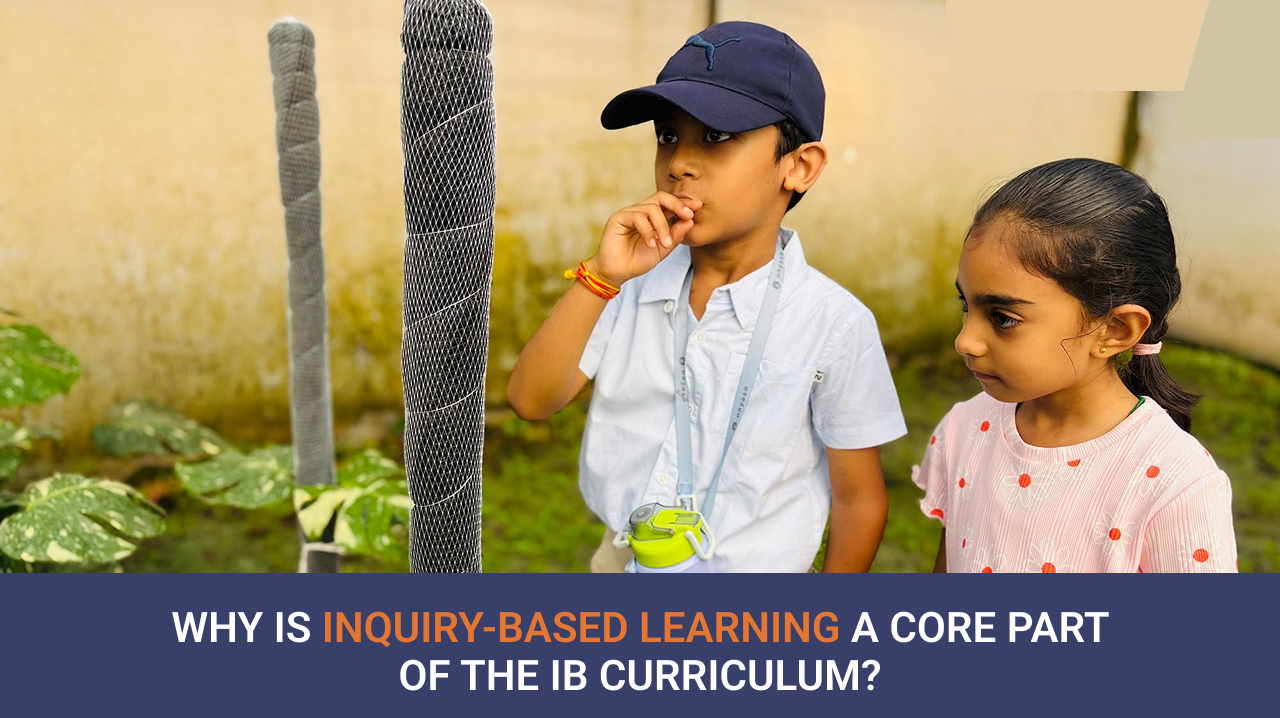
In a passive lesson, students read that plants need sunlight. In an inquiry lesson, they grow seedlings in light and dark corners and work out why.
Understanding children build themselves tends to stick, which is why the IB uses inquiry in every subject.
Why Is Inquiry-Based Learning Important in the IB Curriculum?
How Does Inquiry Encourage Students to Ask Questions?
Teachers help students turn “I wonder…” into questions they can investigate, building independent thinking beyond the textbook.
How Does Inquiry-Based Learning Develop Critical Thinking?
Students sort information, weigh evidence, spot patterns and reach conclusions they can defend.
How Does Inquiry Support Independent Learning?
Most inquiries follow a cycle:
- Identify a question
- Research and investigate
- Evaluate information
- Develop conclusions
- Reflect on the learning
Repeat this often and children start managing their own learning.
How Does Inquiry-Based Learning Develop Problem-Solving Skills?
Real problems rarely have one answer. Students research, experiment, collaborate, evaluate and refine solutions, learning from failed attempts.
How Does Inquiry-Based Learning Work Across the IB Program Curriculum?
Here’s how inquiry grows across the IB program curriculum:
| IB Programme | How Inquiry Can Be Used | Key Student Skill |
|---|---|---|
| IB Primary Years Programme (PYP) | Exploration, questions and investigations | Curiosity |
| IB Middle Years Programme (MYP) | Research, analysis and problem-solving | Critical thinking |
| IB Diploma Programme (DP) | Independent research and subject investigation | Academic inquiry |
PYP learning centres on six transdisciplinary themes and the PYP Exhibition, MYP students complete a Personal Project, and DP students write a 4,000-word Extended Essay. Approaches adapt to age, subject and learning goals.
How Does Inquiry-Based Learning Apply to IB Curriculum Subjects?
Each of the IB curriculum subjects uses inquiry in its own way.
How Is Inquiry Used in Science?
Students observe, hypothesise, experiment and draw evidence-based conclusions. DP scientists also complete their own investigation.
How Is Inquiry Used in Mathematics?
Students uncover the pattern behind a formula, reason why it works and apply it, perhaps comparing mobile data plans.
How Is Inquiry Used in Languages?
Students analyse texts, discuss interpretations and ask: why did the author choose that word?
How Is Inquiry Used in Humanities and Social Sciences?
Learners frame research questions, examine historical sources, explore cultures and compare perspectives on social issues.
What Is the Difference Between Traditional Learning and Inquiry-Based Learning?
Strong teaching under any IB board curriculum blends both:
| Learning Approach | Traditional Learning | Inquiry-Based Learning |
|---|---|---|
| Teacher’s role | Primarily delivers information | Facilitates exploration |
| Student’s role | Learns and applies information | Questions, investigates and evaluates |
| Learning approach | Structured instruction | Exploration and investigation |
| Questions | Often teacher-directed | Often student-generated |
| Problem-solving | Guided | More independent |
| Learning outcome | Knowledge acquisition | Knowledge + skills + understanding |
What Skills Do Students Develop Through Inquiry-Based Learning?
Across the IB syllabus, inquiry steadily builds:
- Critical thinking
- Research skills
- Problem-solving
- Communication
- Collaboration
- Creativity
- Decision-making
- Self-management
- Information literacy
- Reflection
How Does Inquiry-Based Learning Prepare Students for the Future?
Does Inquiry Help Students Become Independent Thinkers?
Yes. Children learn to ask “How do we know that?” before accepting claims.
Does Inquiry-Based Learning Support Real-World Problem-Solving?
It does. Students might measure plastic waste on campus and propose a fix.
How Does Inquiry Develop Research Skills?
By the DP, students can find, evaluate, compare, organise and present evidence, easing the jump to university.
What Are the Benefits of Inquiry-Based Learning for IB Students?
- Builds curiosity and engagement
- Encourages independent learning
- Strengthens critical thinking
- Develops research capabilities
- Improves communication
- Supports collaboration
- Connects learning with real-world situations
- Encourages reflection and lifelong learning
How Does MIT Gurukul Support Inquiry-Based Learning?
At MIT Gurukul, inquiry shapes daily learning across the full IB continuum. Teachers facilitate, and lessons centre on student questions, collaboration and problem-solving.
Younger learners explore themes such as Sharing the Planet, while events like WhyCosmos and Collab with Math connect concepts with discovery. Students from over 30 countries bring varied viewpoints, while sports, arts and clubs extend learning beyond lessons, rooted in Indian values.
What Facts Should Parents Know About the IB Curriculum?
IB Curriculum Facts
- The IB offers four programmes: PYP, MYP, DP and CP.
- The PYP is for students aged 3 to 12.
- The MYP is designed for students aged 11 to 16.
- The DP and CP are for students aged 16 to 19.
- DP students sit final examinations, with a maximum score of 45 points.
- Inquiry is central across all IB programmes.
How Can Parents Identify an Inquiry-Based IB School?
Every brochure says “inquiry”. Ask these questions and listen for specific examples. A school confident in its IB syllabus will show you student work.
- How are students encouraged to ask questions?
- Are students given opportunities for independent research?
- How are projects incorporated into learning?
- How does the school encourage critical thinking?
- Are students encouraged to solve real-world problems?
- How are students assessed beyond traditional examinations?
- How does the school support collaboration and reflection?
Why Is Inquiry-Based Learning Important for the Future of Education?
Facts change; the ability to learn doesn’t. Inquiry:
- Encourages lifelong learning
- Helps students adapt to changing information
- Builds research and analytical skills
- Supports creativity and innovation
- Develops confidence in independent decision-making
- Connects academic learning with real-world challenges
Frequently Asked Questions
What is inquiry-based learning in the IB curriculum?
Learning that starts with students’ own questions.
Why is inquiry important in IB education?
It builds deep understanding and lasting skills.
What are the main benefits of inquiry-based learning?
Curiosity, independence and confidence with real-world problems.
Is inquiry-based learning used in all IB programmes?
Yes. All four programmes use inquiry, adapted to each age group.
How does inquiry-based learning develop critical thinking?
By questioning sources and weighing evidence.
How are IB curriculum subjects taught through inquiry?
Through experiments, pattern-finding, text analysis and source-based research.
Is inquiry-based learning suitable for younger students?
Yes. For young children, inquiry is playful and guided.
How does inquiry-based learning prepare students for higher education?
Students arrive used to independent research and study.
How can parents identify an inquiry-based IB school?
Ask for real examples of student-led research and projects.
How does MIT Gurukul support inquiry-based learning?
Through student-centred teaching, collaborative projects and hands-on experiences.