

IB DP schools in Pune, such as the MIT Gurukul, are among the most advanced schools known for their pioneering efforts to modernise education through various flagship programs and innovative teaching methodologies.
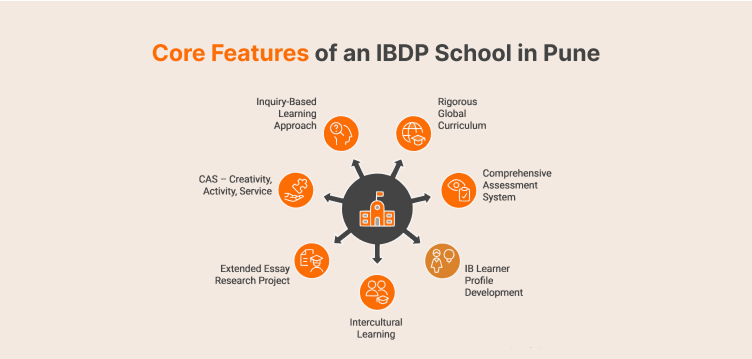
A few key features that distinguish IB DP schools from other regular schools are –
What makes IB DP schools in Pune different from regular schools?
IB DP schools in Pune differ from regular schools through their inquiry-led, globally recognised, and student-centred learning approach. Unlike traditional education systems focused heavily on textbook learning and examinations, IB DP programmes encourage critical thinking, research, creativity, and interdisciplinary understanding. At MIT Gurukul, students engage in holistic learning through components like Theory of Knowledge (TOK), Extended Essay (EE), and Creativity, Activity, Service (CAS), which promote independent thinking and real-world application. IB DP schools also focus strongly on communication skills, global perspectives, leadership, and analytical abilities. This balanced approach prepares students for international universities and future-ready career pathways.
Curriculum Philosophy & Approach
It is vital for parents and students to understand that every curriculum and course structure is
designed with different goals in mind, and that these goals shape how students approach learning, gain knowledge, and apply it.
IBDP Schools – The IB DP curriculum has a course structure designed to support students’ holistic development. The curriculum encourages students to become independent individuals and use inquiry-based learning to foster curiosity, critical thinking, logical reasoning, and creativity.
Regular Schools – Regular schools might mention holistic education as part of their core course structure. Still, due to constraints and book-based instruction, the goals will fall short most of the time, hindering young minds from unlocking their full potential.
Holistic & Broad Learning
Holistic learning and broad learning mostly involve going beyond academics to help students recognise their interests, identify their strengths, and weaknesses.
IBDP Schools – IB Diploma Programme schools ensure students gain many global perspectives while studying by incorporating lessons from around the world. As part of holistic education, IB schools structure lesson plans to help students learn through interdisciplinary methods, where knowledge in one subject helps young minds approach topics in another, linking the learning for a broader perspective and understanding.
Regular Schools – Regular schools do not have a course structure beyond prescribed textbooks, which limits their ability to provide students with opportunities for holistic development.
Unique Core Components
IB DP schools include a few core components in their curriculum that are unique to the IB. The three components that differentiate between an IB DP school and a regular school are –
Theory of Knowledge (TOK): This component assesses students’ depth of knowledge, perspectives, and intellectual understanding of a subject through a long-format, 1600-word essay and a 950-word exhibition.
Extended Essay (EE): Students submit a 4000-word paper on various topics within the given subject. The paper fosters independent, critical, and creative thinking. Students need to choose a topic of their interest and present a research paper as part of the assessment requirements.
Creativity, Activity, Service: CAS is a non-academic core concept of IB DP where students spend an ample amount of time in arts, physical activities, and community service. This approach helps young minds develop empathy, perspective, an understanding of the importance of mental and physical health, and creativity.
Assessment Style
Another important component of IB schools that differs from a regular school is the assessment style.
IBDP Schools – The IB DP curriculum takes a dynamic, deep, and rigorous approach to assessment and tests students across many domains, including analytical and critical thinking, perspectives, intellectual understanding, and depth of knowledge across various subjects and topics. This style helps students prepare for career programs and professional courses with confidence and a solid action plan.
Regular Schools – Regular schools mostly test students on their book knowledge and mostly involve the application of rote knowledge.
Let us now look at another aspect of IBDP schools that differs from that of regular schools.
Key Distinguishing Feature of an IB Diploma Programme School In Pune
One of the most distinguishing features of an IB Diploma Programme school is the structured yet flexible course structure. In this flexible format, students are given plenty of subjects to choose from. They are then taught advanced topics across all subjects using innovative learning methodologies and rigorously tested on them. The structure is as follows –
- Students are to choose six core subjects from the core subject groups.
- They can then choose Higher Level (HL) and Standard Level (SL) subjects.
- The holistic learning approach allows them to study a balanced curriculum in core subjects such as science, arts, mathematics, languages, and humanities.
- Students are then taught advanced concepts in great depth to make them experts in various topics before they graduate.
How Does An IBDP School In Pune Stand Out?
A few other ways that IB DP schools stand out from other schools are –
- Well-defined, rigorous, global course structure.
- Standard learning methodologies across IB DP schools worldwide.
- Assessments involve both internal and external projects.
- CAS programs give students real-world exposure.
- Pedagogy involves developing critical thinking, logical reasoning, creativity, decision-making, independent thinking, and international-mindedness.
- Research-based projects for a deeper and better understanding of complex topics.
- Emphasis on exposure to diverse cultures and global perspectives &
- Emphasis on understanding students through student profiles & more.
Comparison: IBDP School in Pune vs. Regular School
| Parameter | IDBP School In Pune | Regular School ( SSC/CBSE/ICSE) |
| Curriculum Focus | International, inquiry-led and conceptual. | National standards and syllabus-centric. |
| Assessment Model | Internal + External+Performance Tasks. | Mainly board examinations with paper-based testing. |
| Learning Approach | Student-centred and project based | Teacher-centred and textbook-based. |
| Skills Emphasised | Critical thinking, research, reflection and more. | Content mastery and examination performance. |
| Global Recognition | Recognised by universities worldwide. | Recognised mainly within India; international acceptance varies. |
| Community Engagement | CAS requirement and service oriented | Optional/limited |
| Language Programs | Strong multilingual focus. | Often optional second/third language. |
Why IBDP Features Matter for Future-Ready Education?
The IB Diploma Programme is designed for the holistic development of students while keeping future trends and advancements in the educational and professional sectors in mind. As IB DP schools focus on skill development, fostering critical thinking, logical reasoning, communication, decision-making, analytical thinking, and more, they are often considered future-ready. A few aspects that IB DP schools consider while designing course structures are –
Global Skills Demand
According to the World Economic Forum, about 70% of employers worldwide are looking for individuals with critical skills rather than mere book knowledge. This trend has prompted IB DP programs to focus on skill development over rote knowledge.
IB Diploma Programme schools are also focusing on teaching students research and analytical skills, which are extremely important in the current job market. WEF also shows that about 39% job skills will change by 2030, requiring future job seekers to be adaptable and fast learners.
Assessment & Performance Trends
According to IBO, IBDP graduates have an 18% higher chance of getting into Ivy League and other top schools, underscoring the course’s design to help students unlock their full potential.
We hope this article has helped you understand why IBDP schools have the best course structure compared to other regular schools. We now end this article by quoting the leadership team of MIT Gurukul: “Positive thinking is not about denying reality or ignoring problems. It’s about approaching life with a constructive mindset, seeking solutions rather than dwelling on difficulties.”
FAQs
1. What makes an IB Diploma Programme school in Pune different from a regular school?
Commitment to the holistic development of students and a well-structured course structure set IB DP programs apart from other schools.
2. Does IBDP in Pune provide better university prospects than regular boards?
Yes, IB Diploma Programme graduates have better chances of getting into top colleges.
3. Are IBDP schools academically harder than regular schools?
IBDP course structure is more diverse and dynamic than a regular school course structure.
4. Is IB more expensive than traditional schooling?
The fee structure of IB DP schools is defined by the quality of the education and the program’s prospects, making them more expensive than traditional schools.