

Learning and teaching in India has continually evolved with time, making education fun and engaging in each era. Teachers from kindergarten to professional degree courses have consistently adapted to ever-evolving technology, ensuring that students always have the opportunity to showcase their skills and knowledge on the world stage. However, in the past few years, the dynamics of the world’s education system have undergone drastic changes with the advent of AI, and India has been at the forefront of adapting this technology to guide students in their academic journey.
The modern education system is a perfect blend of traditional learning and the aid of technology to understand complex topics better. With the advent of AI, CBSE schools in Maharashtra and other parts of the country have been leveraging the technology to help students in their academic journey. AI provides teachers with perfect live feedback on every student’s performance and offers suggestions on how to improve it by drafting personalised learning plans, breaking down complex topics, and providing additional resources to enhance understanding.
In this article, we delve into the details of how AI is being used in schools to enhance the quality of education and also explore how it is making learning more engaging for young minds.
How is Artificial Intelligence transforming CBSE schools in India?
AI in classrooms might sound futuristic, but it is already happening and it is pretty exciting. At MIT Gurukul, AI helps teachers to understand each student better to offer personalised guidance and support. Imagine lessons that adjust according to the pace of your child or instant feedback that actually helps improve. That is the real impact! From smart classrooms to personalised learning plans, students don’t just keep up, they move ahead with confidence. It also builds digital awareness early, which is a big win for the future. So yes, it’s still CBSE but smarter, more engaging, and far more in tune with how today’s learners think.
The Shift Towards Digital Learning In CBSE Schools
CBSE schools have always focused on addressing issues that are challenging for students, and with the introduction of Artificial Intelligence, educators have taken a step further in making learning easier and fun.
In the traditional teaching methods, the main component was the interaction between students and teachers, wherein educators understood the challenges their students faced and created lesson plans accordingly. However, the huge difference in the student-to-teacher ratio made it difficult for teachers to help their students to the fullest.
With AI and modern technology now in the education domain, teachers can now leverage these tools to create more sustainable and efficient lesson plans that address the challenges of their students, while also paying closer attention to them and exploring new means to enhance their holistic development.
Top CBSE schools in Maharashtra, such as MIT Gurukul, have beautifully combined the benefits of modern teaching methodologies with traditional teaching to help students reach their full potential from a young age.
The CBSE board’s New Education Policy 2020 has enabled schools to adapt to AI, as it encourages educational institutions to introduce the benefits of AI to young minds from their formative learning years. The CBSE board is actively adapting to AI through innovative lesson plans, adaptive learning technologies in classrooms, teacher administration systems, and more, to make learning and teaching more efficient.
How Are CBSE Schools Leveraging AI And Digital Tools?
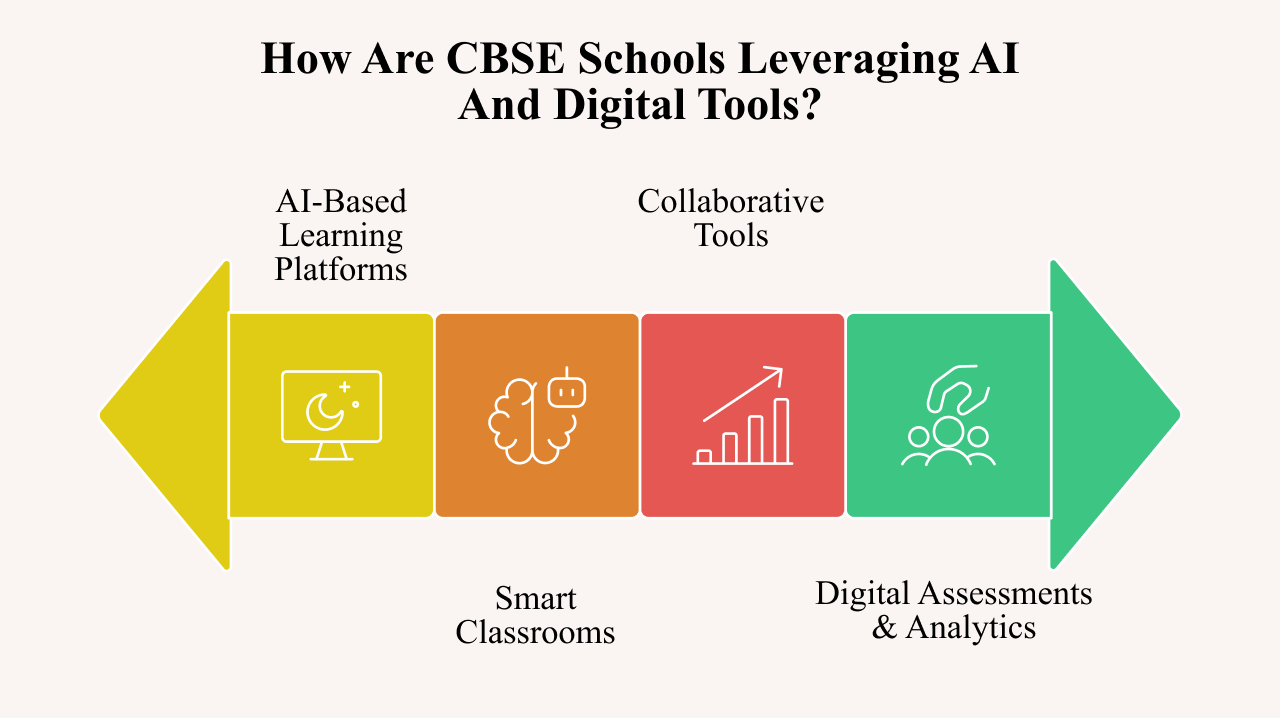
The CBSE board is focusing on helping students leverage the powerful concept of AI rather than working around it. This approach enables students to utilise the tools to their benefit during their higher education years and in their future professional lives. A few ways schools are introducing and using AI powered digital tools are –
Smart Classrooms
Smart classrooms are equipped with tools and technology to help students understand complex topics by using 3D models, practical experiments, and animated educational videos. This technology not only helps students become curious learners but also improves their critical thinking abilities.
AI-Based Learning Platforms
Teachers can help students utilise AI-based learning platforms to create personalised learning schedules, revision tables, and practice tests tailored to their weaknesses and strengths. AI-based learning platforms can make students more confident and independent learners, which are two essential requirements to tackle the challenges of higher education.
Digital Assessments & Analytics
Artificial Intelligence can provide real-time performance feedback on every student’s tests and also provide a detailed report on their strengths and weaknesses. The feedback allows teachers to craft personalised lesson plans and practice questions to improve their students’ overall scores for academic success.
Collaborative Tools
As limiting students from using AI can be challenging and counterproductive, teachers and schools can use collaborative tools to help make assignments and projects more reasoning and critical thinking-oriented rather than memory-based. This process will enable students not only to leverage technology but also to deploy their soft skills, resulting in compelling and meaningful projects.
We hope this article has given you an idea of the various AI-powered teaching methods and how, when employed in the right manner, AI can be a powerful tool in the holistic development of students.