

The admissions process is the most critical step before any student begins their academic journey at their preferred institution. As one of the top IB schools in Navi Mumbai, we have often seen that this process can be jittery for parents due to a lack of information and a stringent process that is overwhelming more often than not.
In this article, we have compiled the criteria that parents must be aware of before starting the admissions process. The article also explains the main reasons for following the criteria and how it can benefit the students in the long run.
What Are The Key Admissions Criteria For IB Schools?
A few of the most important points that parents should keep in mind before starting the admissions process to see if their children meet the IB board’s criteria are –
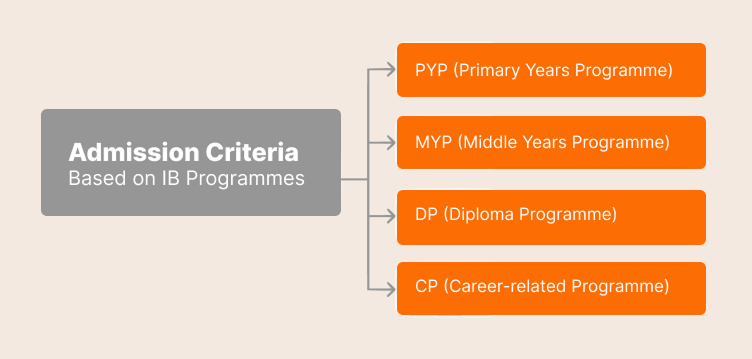
1 – Age Requirements – Students aged between 3 and 19 years are eligible to be part of IB schools under their respective age-defined programs. The Primary Years Programme is catered to students aged 3 to 12; students aged 11-16 are eligible to study in the Middle Years Programme. The Diploma Programme is designed to help students aged 16-19 explore their interests in specialised subjects before they can progress to the Career-related Programme, where they can continue their journey in professional studies across science, commerce, and arts.
2 – Educational Background –Students must have completed their previous grade from IB board schools or any other equivalent recognised educational boards in or outside India.
3 – Academic Performance – Most top schools require students to have a consistent academic record from the past two years as a criterion before joining the school. However, for higher grades, some schools may administer aptitude tests to assess students’ proficiency in mathematics and languages. For the Diploma Programme, students must have maintained a GPA of at least 3.0 during their Middle Years Programme or equivalent grades from other recognised boards.
4 – Entrance Assessments & Interviews – A few IB schools require students to take an entrance test that tests their proficiency in mathematics, English language, and sometimes science.
5 – Language Proficiency – Apart from learning aptitude assessments, IB schools require students to be proficient in the English language, as most of the curriculum is in the same language.
6 – Additional Documents – During the screening process, schools verify the students’ and the parents’ documents thoroughly. A few standard documents that the school asks the students to provide are –
- Birth certificate of the student.
- Address proof from the parents.
- Fitness certificate from a doctor &
- Previous school records.
7 – Recognition of IB Diploma – Students interested in IB Diploma undergo another eligibility test, where their previous academic records are vetted to ensure that they meet the requirements to join the higher-education program from an IB school.
A few other factors that IB schools consider, apart from documentation and academic excellence, are listed below.
Key Factors IB Schools Consider During Admission
The IB syllabus is designed to bring out students’ full potential and support their holistic development. A few factors schools look for in students before the start of their journey in an advanced curriculum school are –
1 – Holistic Profile – The interest of the student to learn and grow both in academics and extracurricular activities.
2 – Alignment With IB Learner Profiles Attributes- Experienced teachers place students in one of the ten learner profile attributes to understand their strengths and challenges better.
3 – Openness To Inquiry-Based Learning – IB schools follow inquiry-based learning. During the pre-admissions process, teachers evaluate a student’s openness to this format to see how fast they can adapt to the curriculum.
4 – International Mindedness – Higher grade students are required to show inclusivity, respect for diverse cultures, and empathy to be part of the IB ethos, and this factor is critical for students before they can join an IB school.
5 – Communication Skills – Communication skills are one of the most important factors that IB schools test to understand whether students can cope with the fast-paced learning environment of the curriculum.
6 – Emotional Maturity & Adaptivity – IB schools also check for emotional stability in students so they can help them adapt to the learning methodology as quickly as possible to start their academic journey.
How IB School Admission Differs from Traditional School Admissions?
| Parameter | IB Schools | National Curriculum Schools | Other International Schools ( Non IB) |
| Focus Of Selection | Holistic evaluation | Academic marks | Academic & English proficiency |
| Assessment Style | Conceptual & skill-based | Knowledge-based | Mixed |
| Parent Involvement | High ( Philosophy alignment) | Moderate | Moderate |
| Global Orientation | Strong international outlook | Primarily national focus | International but varied |
| Subject Selection ( Senior Year ) | Flexible & Personalised | Fixed Streams | Flexible |
Why Is The IB Admission Process Designed This Way?
The IB curriculum is an advanced program designed to support students’ holistic development. The modern education board has a stringent admissions process to provide students with quality education and opportunities for personal development and professional growth. A few other reasons include –
Changing Skill Landscape
A recent report from The Economic Times shows that 82% of employers have difficulty finding skilled workers, making a strong case for early-age skill development. The WEF also shows that about 35% of current skills will become obsolete by 2030, and schools need to adapt to newer education models to make every student’s transition to the professional world smoother.
Rise Of Holistic Education
Top IB schools, such as MIT Gurukul, advocate for the holistic development of students beyond economics, encouraging them to explore their curiosity in various non-academic topics in a safe environment. The inquiry-based learning model requires students to be curious and adaptable, both of which are attributes that are usually screened during the pre-admissions process. A holistic learning approach helps young minds become more confident, develop critical skills, and face the challenges of higher education and professional lives positively.
We hope this article has helped you understand the admissions criteria of IB schools and why they are designed the way they are. We can sum up this article in the words of Dr. APJ Abdul Kalam when he said, “Education gives you the power to think, the power to act, and the power to transform society.”
FAQs
1. What documents are required for IB school admission?
A few documents required before learning aptitude assessments are –
- Birth certificate of the student.
- Address proof from the parents.
- Fitness certificate from a doctor &
- Previous school records.
2. Is there an entrance exam for IB schools?
Some schools might conduct aptitude tests as entrance exams.
3. Can students join IB mid-way?
Yes, depending on the school’s policy and intake limit, students can join IB mid-way.
4. Do IB schools prioritize academic toppers only?
No, IB schools prioritise all their students equally.