


The Finest Practices Followed by Best Preschool in Pune to Make Communication Effective With Children.
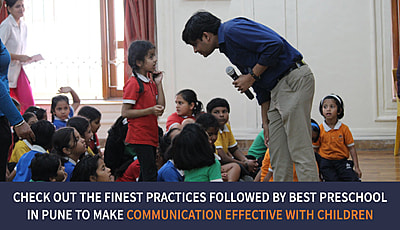
Communication is the bond that cements and holds relationships together, in families, neighbourhoods, societies, and nations. The importance of effective and positive communication with children cannot be undermined. It lays the foundation for their lifelong communicative and interactive patterns that lead to good interpersonal interactions, the ability to maintain associations and relationships, and professional success. There are ways to enhance communication beyond just words and make it deeply meaningful with children to foster understanding, empathy and sensitivity. Pre-schools in Pune, among which MIT Gurukul is a premier institution, employ the following methods for making communication effective with children: Listen to understand the children: Teachers listen attentively and understand what the child is trying to say. They listen without interrupting and nod encouragingly to make the child comfortable in sharing his/her thoughts, emotions or insights. Sometimes the teachers also kneel down so that they are at eye level with the child and can make a close emotional bond. Pick up the emotion: While communicating and listening with children, pre-school teachers and other attending staff also make an effort to tune into the emotions the child is trying to convey. Many times it is the non-verbal cues in a child that need to be understood such as tone of voice, facial expressions, body language etc. International schools in Pune, like the MIT Gurukul, also employ counsellors who are trained in child psychology and who also make informal play-way methods of assessing children’s communicative patterns to help in positive reinforcements in communication patterns. Acknowledging the child’s feelings: Empathy and sensitivity go a long way in making a child deal with any stress or unhappy state of mind. Listening to their emotions and feelings, the pre-school staff let the child get connected with her own mind. This helps the child share with confidence and develop trust in the listening adult’s ability to offer suggestions. This provides a comforting environment in which the child learns to dissipate negativity into positivity. This is also a good way to teach children how to cope with situations that may not be to their liking, by talking openly about them. Understanding the communication from the child’s point of view: We often ignore the fact that negative behaviour or communication by a child may actually be their plea to get reassurance, comfort, security and love from the parents or teachers. By showing benevolence, care and love, pre-school staff, like the team at MIT Gurukul, extract from the children the real reasons that upset them. Without judging or reprimanding they then facilitate the children to overcome the challenging situation. For this, open and free communication patterns between teachers and young students work well. Do not shame the child: Children will feel comfortable opening up about their thoughts, feelings and problems with adults who do not shame them, do not judge or put labels on their feelings, and who do not put down the child by negating their state of mind. The non-judgemental approach in communication with young children helps to make a positive impression on the children. Such children grow to be emotionally responsive, talk about their issues with a trusted individual over growing up years and harness optimism and trust. Talk to the child about many topics: Talking about birds, trees and flowers, or animal species helps to grow the child’s understanding about protecting the environment. Discussion about helping one’s mother in small chores at home like putting the books in place after studying makes them feel responsible. Communicating about different topics in this way raises the child’s social, intellectual and emotional quotient. This is helpful in the long term in developing children into responsible adults and members of society. [INSERT_ELEMENTOR id=”5216″] Conclusively it can be said that making communication effective, empathetic, meaningful and non-judgemental is crucial for the positive personality development of children. Communication patterns should be started early so they can lay the foundation for the holistic development of children for their entire life. We encourage parents to visit the school and discuss with the pre-school staff about effective communication patterns and translate the same within their home environment so that the child obtains more benefits.
How Boarding School Plays a Life-Changing Role in Reshaping Your Kid’s Future
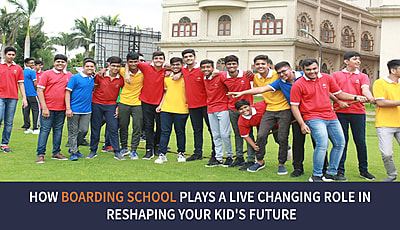
How Boarding School Plays a Life Changing Role in Reshaping Your Kid’s Future As a parent, you want the best educational opportunities that ensure lifelong success for your child. Right from school and up to higher education, your wish is to seek the most suitable institution and curriculum. Another aspect that can help develop your child and provide positive life-changing transformation is the experience of studying in a boarding school. Boarding schools involve the students staying on campus, living with other students and pastoral care staff just like a family. This experience has far-reaching benefits and must be taken into consideration when choosing a school for your child. Some of the benefits that residential boarding schools in India, like the IB curriculum based MIT Gurukul, bring to their students are: 1. World Class Education Most boarding schools follow an international curriculum or have elements of international education woven into their teaching and learning experience. At MIT we have introduced the IB curriculum for our students. Boarding schools provide state-of-the-art student support facilities such as academic counsellors, sports and art areas, safe and comfortable study spaces and home-like living arrangements. These together give the same facilities as any international institution would to its students, and thus the students gain by studying in vibrant and intellectually challenging setups. Even the teachers in a boarding school are selected from among the best in the country. Many have international teaching experiences too that bring in a varied perspective to the pedagogy. MIT incorporates all of these for its students. 2. Co-curricular and extracurricular activities Every student in the best IB schools in India, among which MIT Gurukul is one, is encouraged to have at least one co-curricular and one or more extracurricular activity apart from their educational pursuits. Living in the residential school, the students have access to sporting facilities, art rooms, and futuristic labs. They also utilise creative stations for things like sculpture and design, and participate in community service based student clubs. Students further undertake innovation based science projects and competitions, attend international conclaves, explore creative and business process writing avenues etc. These are available to them to pursue all days of the week. These myriad of offerings develop a comprehensive personality as well as an academic portfolio that makes the student an all-rounder and aids in good admits and possible scholarships as they apply to higher education institutions. 3. Discipline management and sensible independence balance Within a boarding or residential school, such as MIT Gurukul which ranks among the best schools in Pune, there is a balance created between discipline and meaningful independence. Discipline is inculcated through scheduled daily activities and set times for study, meals, recreation, group work, individual time, and morning and night rituals. The students thus grow to be aware of how discipline and punctuality help them in achieving more in all areas of their academic and non-academic pursuits. Simultaneously they also learn to make decisions independently, learn to get along and work positively with peers from different backgrounds. It also enhances their critical thinking, emotional intelligence, confidence and communication ability. These qualities are known to be crucial for success in personal and professional domains later in life. [INSERT_ELEMENTOR id=”5216″] 4. Growing life skills and broadening the student’s horizon Residential boarding schools in India provide a variety of experiences to students, more than non-residential schools. Apart from rich in-class and out-of-class activities as part of the curriculum, for boarding scholars, there are also varied after-school activities on offer. These can include personal coaching in higher and advanced levels of subjects, individual mentoring by experts in sports, creative arts, public speaking etc. There may also be certain excursions and site visit trips to industry, national laboratories, competitions etc. At MIT Gurukul, through these activities we give the students adequate exposure to develop a broader understanding of their innate strengths and to then utilise them in gaining experiences of success and fulfilment. These help in enhancing their life skills such as teamwork, leadership, and cultural sensitivity. Boarding schools thus provide a nourishing environment for the students and help them grow all their personal faculties. This strong foundation becomes the strength for the students as they embark upon higher education journeys and later step into their professional fields. MIT Gurukul, being aware of the importance of giving its students the best boarding school experience has excellent pastoral care and enough educational and other offerings. They also have a team of dedicated teachers, pastoral care staff, subject, art and sports experts and student services like the career advising to enable the students to get the best school experience of their life. We invite prospective parents and students to visit our campus and make informed decisions to enrol their children at our boarding school. You can write to admissions@www.www.mitgurukul.com to fix a schedule for your campus visit.
5 Reasons Why You as a Parent Should Consider IB Education for Your Child

IB, or the International Baccalaureate, is a high school diploma that is fast becoming a popular pedagogical choice with Indian parents and students. This internationally recognized educational option is known for raising critical thinking, enhancing the creative approach to studies, and improving the writing ability among students. At MIT Gurukul, one of the best IB syllabus schools in India, we have adopted the IB diploma curriculum and seen the positive results of our students through this program. There are many advantages for parents to choosing the IB diploma schools for their children. Some of the main reasons to study the IB curriculum are: The breadth of study subjects: IB students study subjects from six different groups that include languages, humanities, science and Math among others. This gives them a vast canvas of knowledge and also helps them make connections between subjects. The IB curriculum enhances their depth as well as breadth of know-how and encourages a multidisciplinary approach to gaining knowledge. Students also make connections between classroom concepts and real-life applications, such as the concept of kinaesthetic as it applies on the sports field. Experiential learning: Creativity, Activity and Service (CAS) is the foundation of IB education. The function of this is to give the students varied opportunities of learning through student clubs, projects, learning by doing, and working to do service for others. Sports, co-curricular activities, field visits, laboratory experiments, presentations and transferring the learning to writing all form part of the IB curriculum. Students are also given the freedom of creative expression and to follow special interests for holistic development. At MIT Gurukul, one of the top 5 schools in Pune, we provide all these avenues to our students to bring their latent talents and innate abilities. [INSERT_ELEMENTOR id=”5216″] Independent thinking and research skills development: The Extended Essay and the Theory of Knowledge are two crucial components of the IB diploma. These writing exercises require a student to make an independent inquiry on a topic of interest, view it from various perspectives, make critical analyses and write their own perceptions, ideas and solutions for the same. The teaching also involves active two-way communication between the teacher and the students. The students have the freedom to voice their opinions and ideas respectfully, listen to others’ ideas and display mutual respect for differences in the ways each student processes the information. This develops empathy, thought analysis, listening and speaking capabilities in students. Time management capacity building: Within the academically rigorous curriculum of the IB diploma, students learn to manage time effectively for all their educational and other interests. They learn fast how to set time slots for studies, projects, student clubs, out-of-classroom interests, competitions, group assignments, and organizing events. Thus students are more likely to avoid distractions and gain quality of focus and concentration. They also learn to challenge themselves within the stimulating and exciting learning environment of the IB diploma program. Suitability for stepping into overseas higher education: The IB diploma prepares the students in ways that help them transition into their higher education in any global university or college seamlessly. This also gives them exposure to international paradigms of education and guides them towards global citizenry, which is important in an increasingly interconnected world. The IB diploma students obtain successful admits in larger numbers in the top-ranked universities in the world and are able to manage the rigours of those programs well. Conclusively, we can say that the IB diploma program has lots of advantages in helping build children’s future career paths, their personality, independent thought process, teamwork, time management and research acumen. We invite the prospective parents to visit our campus through a pre-scheduled appointment and to discuss the details of the methodology of the IB diploma at MIT Gurukul. You can write to the IB coordinator at admissions@www.www.mitgurukul.com to set a visit schedule.
8 Best Ideas to Keep Your Child Stay Organised
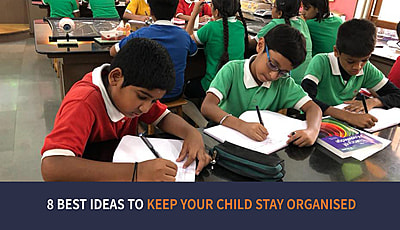
Why Staying Organized is Essential “People form habits, and the habits form their lives.” At MIT Gurukul, we concur with this adage fully and appreciate its wisdom. Being one of the top IB schools in Pune, we grasp that staying organized is a sure way to get more done in less time. It helps one achieve quality results from the daily schedules, and achieve one’s goals in a seamless manner. Getting into the habit of maintaining clutter-free environments, setting reminders and keeping timeline calendars are some ways to help a child get into the habit of making the most of their time. It leads to more productivity, higher output and better quality of one’s study or work week. Forming these organizational habits is crucial at an early stage, and some of the ways in which the home and the school can encourage and help children stay organized are as under: · Setting timetables: Time tables put tasks and activities for a child in slots of time, and help them navigate their day in a predictable, easy to follow and hassle-free manner. They also develop in the child the capability of understanding the logical sequence of study, play, extracurricular activities, and meal and rest times. Time table teaches them time management skills for the long term, which they can use in their higher education and professional years later. At MIT, one of the top residential schools in Mumbai, we give each child a personalized timetable that they are also encouraged to check and follow. · Creating Memory Aids: Memory aids include associating tasks with certain symbols, things or reminder stickers that can be displayed at places that are within the child’s vision. Examples can include associating study time with the symbol of addition and multiplication which symbolises adding knowledge and multiplying skills. Small jingles for remembering important tasks for the day like completing homework, setting clothes for the next day, packing bags etc can put the fun in the child’s schedule. · Using Checklists: Checklists are lists of items to pack, things to accomplish in a certain time, study aids that need to be collected at one place for a project etc. By making and following checklists the child ensures that all equipment or accessories are together at the beginning and does not need to keep going back to get more items once the task has started. This habit inculcates in the child logical sequencing, understanding the interdependence of things with each other and how they are all essential to form a complete whole from individual parts. This works to raise the logical understanding quality in children. · Colour coding: Colour coding subjects, activities, times of the day etc. are fun ways to teach the child to remember important schedules, activities and projects based on certain colours. Associating green for gardening, blue for watercolour work, red for arts and theatre, yellow for waking up early, black for setting the bag and uniform at night for the next day can be some colour associations. The child can also be taught to associate colours with personal qualities that help him become more organized. This can include white for being neat and tidy in one’s workspace, pink for consideration for others and maintaining work boundaries, and yellow for consistency and discipline. [INSERT_ELEMENTOR id=”5216″] · Weekly clean-ups: Among the best IB schools in Mumbai, Pune, Bangalore, Delhi and the rest of India, MIT Gurukul lays great importance on cleaning and organizing workspaces. The students are motivated to set their own study desks, tidy their residency rooms, and maintain their stationery items in workable formats. This ensures that every student grows a sense of responsibility, using resources in sustainable ways and respecting the study spaces of other students. · Using dashboards: Dashboards are pin-up boards where a child can put up their artwork. It can be used to put up reminders for important tasks, exam schedules, mark dates for their school events, their friend’s birthdays and anything else that they want to. These multipurpose boards have a great role in making the recall value for things better for the child and for them to vent their thoughts, and creative ideas and work in one place. · Peer and sibling pairing: Pairing siblings at home and making groups of two at school as organizing buddies is an unconventional yet very effective tool to help a child remain organized. By setting up timetables and schedules to work out together the sibling or school buddy becomes a point of reference for the child to work in a pair for maintaining time slots of combined activities, studies, cleaning up and setting a plan for the coming week. Doing things together also raises the motivation levels of children to keep up with their more organized buddies. · Slots on work desks or shelves: This method is also in vogue and involves making work desk drawers into daily activity material holders. The child puts the materials to be used for each day of the week into the slots at the beginning of the week and thus keeps reminded of what is to be achieved during the week. This saves time for the child at the actual time of the activity since the study or other activity materials have been gathered in one place already. Call to Action & Conclusion In conclusion, we can say that the habit of keeping organized should be developed early and its benefits go a long way till the end of a person’s life. We request parents to adopt some of these into their child’s life and help them become focused on their study approach. We also encourage parents to visit the school and discuss different methods to help their child stay organized with their respective class teachers.
Top 5 Benefits of Extracurricular Activities in Child Development
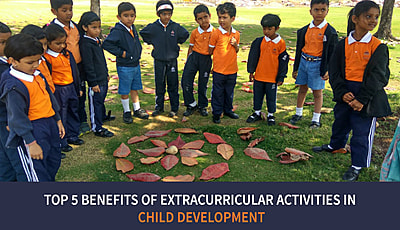
Introduction: Purposeful education is meant to nurture the latent abilities of children, bring forth their interests and abilities in creative pursuits, and help develop their overall personality. Thus a complete educational experience includes both academic as well as extracurricular activities, with both playing complementary roles to each other. It is being increasingly recognized the world over that extracurricular indulgences are beneficial for the intellectual, artistic, social as well as psychological growth of students. Some of the benefits associated with undertaking extracurricular activities include: 1. They help develop the social and moral character of children: Through sports, team-based competitions and community work; students develop qualities of focus, discipline, taking care of one’s teammates, healthy competitive spirit, and selfless giving. These become part of the students’ persona and help them navigate life while contributing meaningfully to society. MIT Gurukul, one of the best residential schools in Pune, has world-class sports facilities, art labs, music rooms and community outreach programs for the students. This reflects the school’s commitment to developing its students holistically and preparing tomorrow’s empathetic leaders. 2. They expose the children to new opportunities and interests: Participating in numerous activities, children are able to find their niche interests in new and uncommon hobbies or rare art forms. Some of these may include playing traditional country sports, bookkeeping, growing vertical gardens, campaigning for the preservation of endangered species, developing socially relevant apps etc. These look good on a child’s resume while it also makes them stand apart from their peers. At MIT Gurukul, a premier international school in Pune, professional artists, social activists, environmentalists and social and civil society organisations are regularly invited to interact with students and motivate them towards taking up such extracurricular activities. 3. They provide meaningful social outlets: Extracurricular activities very often pitch students into group projects and take them outside the classroom setting. This makes them network with students from different institutions, travel to new places and experience varied cultures, settings and lifestyles. Such exposures broaden the students’ visions and help them become flexible and adaptable in getting along with, and working with people from varied backgrounds. This helps them become successful in their professional and personal endeavours in the later years of their lives. 4. They provide a break from the monotony of studies: Extracurricular activities provide a welcome break from studies and actually contribute to better academic performance by making the students mentally and physically fit, alert and sharp. Alternating rigorous study times with the pursuit of hobbies and interests raises communication, critical thinking, and scientific expertise of the students. Such activities can include debating, public speaking, science or social science projects, planting trees, playing chess or participating in Model United Nations. They allow the students physical movement, networking with like-minded students, forming social bonds and learning through non-academic means. 5. They give the students essential life skills: Extracurricular activities give the students qualities that classroom education cannot. These include priority setting, time management, problem-solving, looking at different perspectives, analytical thinking, optimism, self-confidence and camaraderie. Mastering these skills benefit the students throughout their life, in their personal, professional, psychological and social spaces. Among the best schools in Pune, MIT Gurukul has consciously crafted a comprehensive curriculum that offers different extracurricular opportunities to the students for their benefit in the present and their success in the future. Conclusively we can say that extracurricular activities are an essential part of the educational ethos of a school, a society and a country. Though all ages are good to participate in such activities, developing an early interest in them from school days gives lasting benefits in all stages of life. Deeply committed to giving every opportunity to the students for extracurricular immersions, MIT Gurukul urges the parents to also support and encourage their wards to enthusiastically participate in such activities. To see the entire range of extracurricular activities offered at our school, please visit our website https://www.mitgurukul.com/.We also welcome parent volunteers to take art and craft classes, teach music and singing, or train the students in cooking, embroidery, languages or tech based training.