


Experiential Learning – Real Life Application of Education
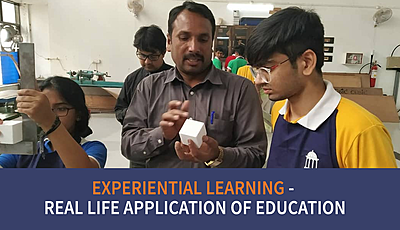
This statement by the great statesman rings true in all times, and in modern terms refers to the ‘experiential learning’ methodology. Experiential learning collectively means the specific ways of learning by getting involved in activities beyond just imbibing theoretical concepts. It involves things like the play way method of teaching and arts and crafts for younger children; field trips, experimentation, research, lab work, group presentations, competitions, and innovation and commercialization of those innovations for older students. Experiential learning includes primary research, assignments and activities based on real-life situations. The primary research engages the students with reflective problem solving and opens multiple potential avenues of inquiry. This helps enhance their critical thought patterns, logical deductions, and the ability to seek varied perspectives to approach a situation. Some of the best residential schools in Mumbai, Pune, and other parts of India thus increasingly employ on-campus experiential learning activities as an integral part of the pedagogy. At the primary level, experiential learning could involve things like clay modelling, art and craft activities, and visiting a zoo or an aquarium to learn about animals and sea life. A visit to a pottery workshop, or just walking in the park to see various trees and plants. Experiential learning for middle years includes, among others, things like making a gyroscope, growing mould on wet bread to learn about fungus, germinating seeds to see how plants grow, working with prisms to understand different colours of the rainbow or visit to planetariums, science parks, etc. In the high school, experiential learning takes on a more advanced form through lab work, research papers, visits to geological sites, rocket launching facilities, national research laboratories, and internationally to places like NASA research facility, participation in subject-based, sports, art or other competitions, innovating products and applications etc. Good schools in Pune, the education capital of India, are well known to employ such learning techniques in their curriculum. [INSERT_ELEMENTOR id=”5216″] MIT Gurukul, one of the most renowned and among the best schools in Pune, is at the forefront of such educational ethos. We have found through experience that students who are exposed to experiential learning are able to tackle their subjects better, are more creative, become better at teamwork, leadership potential and communication skills, develop research acumen, and thus are more confident in their scholastic and other tasks. They also have holistic personality development through co-curricular indulgences. The teachers also play a definitive role in such experiential learning through encouraging facilitated and guided practice, reflection, and evaluation amongst students. In a nutshell, experiential learning through open-ended discussions and questioning guidance, experimentation and immersion in tasks, allows students to develop ideas, test them, and enjoy successes. It also facilitates learning and growing from failures, engaging in continuous intellectual development, and finding ways to overcome challenges. These life skills are very important in goal setting and goal achieving at every stage in life. MIT Gurukul invites and encourages all current and prospective parents to attend our open house sessions and see first-hand our experiential learning facilities, meet the teachers and get their questions and queries answered to satisfaction. To see our schedule for upcoming events and open houses, please visit https://www.mitgurukul.com/ “Tell me and I forget, teach me and I may remember, involve me and I learn.” -Benjamin Franklin
The Subject Choices in High School – Preparing for Your Future Education
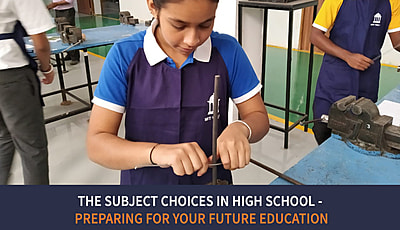
The subjects that the students choose in their high school, have an influence on their life and career ahead. To know the exact trajectory of one’s career path one needs to make the correct first decision in taking subjects that will build into both future education as well as a future vocation. For example, to undertake a career in Marine Biology, it is important that a student studies both Biology and Math at the school level since Marine Biology includes elements of statistical data collection of marine species. In absence of the correct guidance, many talented students’ career ambitions would find regret in the hindsight. At MIT Gurukul, one of the international residential schools in Pune, we are mindful of the fact that students, and many times their families, need guidance from higher education experts and college counsellors for making the right selection of the subject mix. Thus we have a dedicated cell that interacts and discusses with the 10th-grade students on their: Subjects of interest Possible career choices Innate strengths and proclivity towards science, arts, commerce or humanities The aspiration to undertake further education in India or overseas Possible roles and designations they hope to obtain in their professional career This helps initiate the first formal undertaking of careful planning for subject choice in the 11th grade, which is the stepping stone to selecting a focussed subject stream. This involves segregating the subjects into science or arts, commerce or languages, and then picking one (sometimes two) that the student feels most confident in tackling. At MIT Gurukul, one of the best international schools in Pune, this is the time that the higher education experts step in along with study abroad advisors and provide insights towards bachelor’s courses and what their prerequisites are. The final step in this process includes making the firm choice for the combination of subjects that the student will study in grades 11th and 12th. [INSERT_ELEMENTOR id=”5216″] We also adopt the approach that each child is unique, with their individual career dreams and ambitions, and process the same information in a way that is individualistic and innate. Thus we map the students’ personality, strengths, aptitude and future dreams. We employ the scientifically tested methods and psychometric tools for this purpose. We also spend time with the students and their families to mitigate the factors that may influence an incorrect subject choice, such as societal pressure, unrealistic expectations from the student, peer pressure etc. The ultimate aim is to take the student from confusion, to clarity and certainty about the subjects and what career paths they can lead to. Finally, it is our endeavour to inform the students that stream selection is not a daunting task. Once the short term career vision at least is put into perspective, we trace backwards to the present day and which subjects will lead to the future career that the student is keen on. Being one of the Best boarding schools in India, we also pride ourselves in knowing our students closely and being their mentor and friends in helping them in high-school subject selection. We also hold regular seminars by subject experts and professionals to discuss their own professional trajectory and which subjects they pursued in school. We also hold individual career sessions by appointment for students and would be happy to receive your request at admissions@www.www.mitgurukul.com for a personalized session with you and your child.
Decoding the IB Curriculum: Why is it Good for Your Child
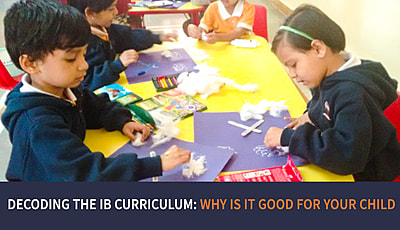
The IB or the International Baccalaureate diploma refers to a two-year academic program that is offered to students in the age group of 16 to 19 years. Internationally accepted and recognized, this curriculum has gained immense popularity in India in the last two decades. The IB Diploma is a significant credential for college applications, especially overseas. Being aware of the advantages of this pedagogy, MIT Gurukul, one of the best IB schools in Pune, has consciously adopted the curriculum. The IB Diploma requires the students to study and pass exams in six subject areas. Three or four of these subjects can be taken by the student at the challenging “Higher” level, while the remaining subjects can be taken at the “Standard” level. Additionally, the students write an essay based on independent research by taking the “Theory of Knowledge” course. This course covers critical thinking and epistemology. The third mandatory requirement of IB Diploma is for the student to participate in various extracurricular activities for holistic development. [INSERT_ELEMENTOR id=”5216″] Getting the IB Diploma signifies that the student has superior critical thinking due to a heavily experiential pedagogy. They are also equipped to analyse and understand information, look at varying perspectives and develop problem-solving abilities. Some noteworthy advantages of learning the IB curriculum are: 1. High Acceptance Rate : Students holding an IB Diploma have a high university and college acceptance rate worldwide. The experiential curriculum gives them qualities also to be very successful in their college education. 2. Increased Scholarship Opportunities : It has been observed that students who have passed the IB curriculum from top schools in Mumbai, Bangalore, Delhi, Gurugram etc. obtain greater scholarships and fellowships. 3. Interdisciplinary Teaching : The method of instruction used in IB Diploma is interdisciplinary and multidisciplinary with hands-on learning, rendering the students with broader academic horizons. 4. Development of intellectual faculties : Students taking IB Diploma are trained to approach research and inquiry, find answers through independent exploration of multiple learning strategies, adopt new ideas, be expressive, and gain knowledge on issues that have local and global significance. 5. Honing Liberal Minded and Global Outlook : Students of the International Baccalaureate Diploma Program understand and appreciate different cultures and life views. They are open to accepting varied perceptions, values and traditions, and become educationally richer with such realisations. 6. Ingenuity : Within the IB pedagogy the students develop their imaginative and scholarly quotient to deal with a variety of educational paradigms right from the early years and up to the high school years. At MIT Gurukul, one of the best primary and high school in Pune, we encourage hands-on work and experimentation. 7. Teacher Development : It is a mandate of the International Baccalaureate (IB) Organisation for teachers to undertake regular professional development training. Thus the students learn from the most informed and talented educators. Conclusively, pursuing IB Diploma opens up a plethora of opportunities for students, and with the above-mentioned advantages it offers, it is surely a pedagogy that is aimed for student success. We encourage all prospective parents to book a session with our admissions team to learn more about our program and its salient points.
Holistic Education – Developing Leaders Beyond Just Classrooms

MIT Gurukul was founded on the principle that along with learning in sciences, arts and sports, students must develop reverence for and connection with the natural habitats, their communities and the humanitarian values of compassion, care and empathy. In keeping with this vision, MIT Gurukul, being one of the best international schools in Pune, has developed a holistic approach to education. The aspiration of our educational ethos is to send out young ambassadors from our school into the world who become change-makers and become the personification of our values. To achieve this end, our education is crafted around various activities and experiences that extend beyond just classroom education. Our schedules include discussions on human values and the importance of empathy, the innovative zeal and approach to studies, creativity in putting one’s learning to the benefit of society, and leadership qualities of fairness and inclusivity. The timetable also has provision for visits to old age homes, orphanages, schools for differently-abled students, and the like. These visits are not just mere excursions but more of practical learning. We discuss ways in which the students can contribute and also give them follow-up exercises as a practice. Thus our school has done generous donations of books, stationery, clothes, medicine, and various other aides. This practical learning has encouraged our senior students to volunteer and teach the underprivileged free of cost. These millennial kids are leveraging the power of social media to create awareness about such social issues. love for nature is also a part of our life’s vision. Being an international residential school in Pune, MIT Gurukul fructifies a feeling of family among its students and the qualities of care and concern for each other. Included in our definition of family are also the green cover at our campus and the serene Mula Mutha river that flows on the side of our school. Thus our students participate in cleanliness drives, and cultural events to mark respect for nature. Students help maintain the green cover by being mindful of not damaging the trees or the other saplings. Tree plantation has been a yearly activity and every sapling thus planted is then nurtured and grown. We are sure that the students will carry this outlook further in their lives and spread the message for the preservation of nature as young scholars. [INSERT_ELEMENTOR id=”5216″] The international baccalaureate syllabus is also leaned toward the idea of learning by doing, making inquiry and conducting research and then arriving at thoughtful and evaluated conclusions. Thus the emphasis is on deep-diving into history, synthesising science through experimentation, arts through performance, and sports through collaboration as much as competition is the way of life at MIT Gurukul. The underlying motivation in our teaching and learning method is that students utilize their knowhow for making the societies around them better. Hence we showcase theatre on social issues like education or gender equality, conduct team-based sports to espouse cooperation among students, encourage travel to broaden their horizons and support debates and discussions to develop their critical thinking abilities. For we believe that no education is complete unless it develops a compassionate human being, rather than just a professional! It is our constant endeavour to impart the best and holistic knowledge to every student who enrols with us and to refine their inherent human qualities. We would be happy to have some parents mentor our students through invited sessions on topics of success with social values, idea of participatory work, volunteering and community outreach, and using art for expressing human values. For expressions of interest please write to admissions@www.www.mitgurukul.com