


Eight Reasons Why Daily Morning Prayer is Important for Children

Have you ever wondered why schools emphasize daily morning prayers for children? Your child is a gifted spirit, bustling with energy, potential and ideas, which need to be channelized in the right direction. Consistent morning prayers have been known to be beneficial for this. Below are enumerated eight points to support this and to understand the importance of a morning prayers routine: 1. Prayers Help in Developing Better Decision-making Skills Should I complete my homework or play some video games? Should I be there for my friend or ignore her when she asks for help? Should I choose this, or should I choose that? Children have to make many decisions throughout the day, and sometimes, they have to do it without external help. Morning prayers help them remain calm to make informed and better decisions. They also navigate their choices during the assembly and understand what the best option is for them. 2. Prayers Ensure a Fresh and Positive Day The best international schools in India create a positive atmosphere right from the morning assembly. Students can therefore start a new day with positivity and look forward to the new opportunities, lessons, conversations and games that the day brings. At MIT Gurukul, a leading IB school in Pune, we conduct combined morning prayers with all students present, setting the day’s tone and inspiring children to have a fruitful and mindful day, work in teams and be sensitive towards each others’ needs. In India, studies report that 21–26% of adolescents suffer from anxiety disorders, showing why practices like morning prayer that promote calmness and positivity are essential. Also Read Academics at MIT Gurukul: World-Class Education for Your Child’s Future Holistic Education – Developing Leaders Beyond Just Classrooms How can empowering children help build a better world for them? 3. Prayers Empower Students to Address Inner Difficulties During the morning prayers, children may talk silently to God about their hardships. This helps them to identify their problems and pay enough attention to them to look for solutions. They learn to be patient in the face of adversities, feel hopeful and are empowered to look for solutions by the end of the prayer. Studies on gratitude practices among children show that regular reflection, like prayer, reduces depressive symptoms by up to 23% and increases optimism. 4. Prayers Foster Healthy Communication and Relationships At MIT Gurukul, one of the best residential boarding schools in India, we go beyond reciting prayers just for the sake of it. During the morning assembly, we encourage our children to connect with God with an open mind and create a deeper spiritual relationship. This practice naturally teaches them to communicate better with their parents, friends and teachers, too, as it helps elevate their empathy, respect for others and desire to make positive interpersonal connections. [INSERT_ELEMENTOR id=”5216″] 5. Prayers Teach Students to Count Their Blessings During the morning prayers, children count their blessings and feel grateful for all they have. They do not take their lives for granted. They begin their day by thanking God for the wonderful blessings in their life and also aspire to contribute to society through community work. 6. Prayers Help Release Stress and Anxiety At MIT Gurukul, our years of experience with children have taught us how morning prayers help release their stress and anxiety. It helps them to feel light from the inside, concentrate better and have a joyful learning experience. 7. Prayers Aid the Development of Consistency and Self-discipline Did you know that preparing for the daily morning prayers is also a crucial part of the prayer? When children prepare for their morning prayer, they develop a habit of consistency and self-discipline. They understand the importance of showing up daily and imbibe punctuality, cooperation and time management. 8. Prayers Help in Positive Transformation When children pray faithfully, they think about the habits they want to change. They address the desire for transformation in their minds when they converse with God. This leads to a strong belief that they are capable of change and their transformation in the right direction is always possible. At MIT Gurukul, our curriculum is designed in a balanced manner to help students learn in-depth concepts without getting confused or overwhelmed. Many of our students go on to study courses like IBDP business management or other areas of interest. With the habit of daily morning prayers that we instill in them, they master the art of studying calmly, working effectively and living joyfully. In a similar way, we urge the parents to set up a night prayers routine just before going to bed that will help make their children feel calm, happy and have a good quality sleep, which will prepare them for the work of the next day.
Why Is International School Education Gaining Importance Day By Day?

Are you about to make an important decision for your child’s education? Looking for the best educational options? It is likely that you have come across the concept of international school education. It’s trending! More and more parents are opting for it to give their children the most enriching learning experience. But why are international schools gaining so much importance day by day? We’ll help you figure this out in the points discussed below. Read them carefully to make an informed choice for your child’s education: 1. International schools offer a huge platter of extra-curricular activities IB schools have been leading the game of extracurriculars with in-house facilities and brilliant trainers. For instance, at MIT Gurukul, one of the best residential boarding schools in India, we do not restrict your child to academic performance alone. Whether your child loves to paint, tell stories, dance or solve puzzles, play sports or develop tech-enabled innovations, we help them excel in it and realise their potential. 2. They provide innovative teaching in smart classrooms This is undoubtedly one of the most important reasons why international school education is growing faster day by day. IB school teachers are trained to keep up with the most effective teaching methods and the latest research. Moreover, international schools have smart classrooms to help students grasp new concepts in the easiest manner, supported by digitally enabled spaces and student learning areas. The advanced infrastructure and state-of-the-art technology boost your child’s curiosity, confidence and skills. Also Read International Schools: Top Five Differentiating Characteristics Why Teaching methodology and pedagogy in International school is different from other regular school? Holistic Education – Developing Leaders Beyond Just Classrooms 3. They walk the extra mile to ensure special care and individual attention International schools have a low student-teacher ratio. Therefore students get undivided attention from their teachers and can approach them for any help they require. At MIT Gurukul, we always walk that extra mile to understand your child’s individual needs, the pace of learning and areas of strength and weaknesses. The best IB schools in the world follow this approach, and we’ve witnessed our students receive the most fruitful results from it. [INSERT_ELEMENTOR id=”5216″] 4. They build your child’s social skills early on International schools have a diverse set of students as well as teachers. This helps the students’ cultural sensitivity, ability to work with a diverse set of people and thrive in multicultural environments. Moreover, the IB PYP syllabus has been built in such a way that it fosters social skills in children. Through interactive sessions, programs and group study, they make friends from diverse cultural backgrounds and learn how to live in harmony. Now, how does this really help your child in the long run? In our modern society, networking is imperative to succeed and grow. In future, connections with people from various walks of life will fetch your child an array of new opportunities to thrive. Also Read 5 Primary differences between International schools and National School The Finest Practices Followed by Best Preschool in Pune to Make Communication Effective With Children. Journey of Right Learning Begins with the Right Preschool 5. They know what it takes to make a global leader Global awareness and leadership qualities are not built in a day. They require an environment that is stable, disciplined and nurturing. International schools leave no stone unturned to succeed at this. The IB program presents global perspectives in front of students and establishes a multicultural learning environment. Children learn to cultivate a habit of respect and compassion. This is why innumerable students from international schools emerge as global leaders, and the interest in international school education is rising rapidly. At MIT Gurukul, we religiously follow these methods and ensure that your child has a joyful learning experience. The benefits of our curriculum and teaching methods take our students one step ahead wherever they go. If you are interested in enrolling your child in our school, you may write to admissions@www.www.mitgurukul.com to fix a schedule for your campus visit.
Meditation in School: 10 Tips, Techniques and Benefits to help you get started!

With the fast-paced academic schedules, and pressure to perform well, the stress levels in students are on the rise. As a parent, you want your child to be relaxed, optimistic and focused to ace their subjects and score well. Do you know there is a wonderful way to reduce stress, boost concentration and create a mindful classroom experience for students? The simple answer to this is – meditation in school. In this blog, we share tips on how schools make meditation schedules effective and beneficial for students. If these inspire you, you may look to instil brief medication hours within your child’s schedule. 1. Selecting the right time Schools, such as MIT Gurukul, choose a time for meditation when teachers and students: can relax without any disturbances can develop it into a habit by keeping this slot fixed hone a calm persona and a fresh mind to concentrate on studies We avoid doing this during the last periods because everyone is tired and eager to reach home and rest. MIT Gurukul, like many good schools in Pune, has found that the time after the assembly or morning break might work wonders for a meditation session. Also Read Best Ideas to Keep Your Child Stay Organised The Finest Practices Followed by Best Preschool in Pune to Make Communication Effective With Children. 2. Keeping it short and effective At MIT Gurukul, one of the top-ranked schools in Pune, we introduce meditation sessions to young students by keeping them short and effective at first. Starting with two minutes in grade 1st, we then scale meditation sessions to fifteen-minute slots by secondary and high school. You can apply this meditation schedule by keeping the session for five minutes for primary school children to twenty minutes for your high school child. 3. Setting some prompts to begin the session MIT Gurukul employs creative communication patterns to get students to like meditation sessions. We avoid saying, “Good morning, class. Let’s start our meditation for today.” Instead, we say, “Alright, everyone, please sit comfortably and relax your shoulders. You can keep your hands on your desk or your lap. Now close your eyes slowly and take a deep breath. We are going to relax our minds and develop our concentration to study well.” Now that you know the tips to get started, let us look at 3 useful techniques of meditation that we deploy in school to benefit your child: Also Read Sporting Culture at MIT Gurukul the why and how of it The Art Scenario at MIT Gurukul – Developing the Creativity Index Benefits of Extracurricular Activities in Child Development [INSERT_ELEMENTOR id=”5216″] 1. The famous balloon technique: We ask our students to imagine a balloon inside their tummy. Let them inhale and hold their breath till three counts, imagining that the balloon is getting inflated. Then we instruct them to breathe out as if the balloon is slowly getting deflated. This helps release stress, and whenever they are upset, they can practice this with an imaginary balloon of their favourite colour. 2. Connect with nature and appreciate it We take our students to the school garden and let them listen to the chirping of birds in silence or the calming sounds of the Mula Mutha river. At home, you may also sit down with them, touch the green blades of grass and meditate, or sit in the balcony early morning and meditate surrounded by plants and birds. 3. Use of guided relaxation method Many times we play guided meditation audio in the class and help students hold their thoughts and relax their brains. We let the voice guide the students through the session, speaking calmly and taking it slow. The medication instructor may ask the students to let go of the tension in their body parts one by one. Then he asks them to imagine a peaceful place and guides them through the process. With the help of such techniques, MIT Gurukul, an IB (International Baccalaureate) school, has made meditation a priority. But why do the best IB schools in the world encourage this practice? Here are 4 benefits that explain this: 1. Intelligence: The IB MYP (Middle Years Programme) fosters intelligence through a well-balanced curriculum. Meditation improves the brain and academic performance. Therefore, IB teachers and students greatly benefit from it. 2. Calmness: Meditation helps teachers and students to calm their minds and also reduces stress, depression, anxiety, and ADHD symptoms in students. 3. A healthy heart: It has been found that those who meditate regularly are less prone to cardiovascular diseases later in life. 4. Mindful choices: Teachers and students who meditate remain mindful throughout the day, and thus teachers can teach better while students can learn well. Also Read Can Teachers and Parents Work Together to Facilitate the best learning Experience for Kids. The Subject Choices in High School – Preparing for Your Future Education These benefits help our teachers at MIT Gurukul to be more mindful and enjoy their teaching experience. At the same time, our students learn to cultivate awareness, affection and empathy through this simple initiative. Therefore, we highly recommend meditation in every school, and at each home, for a remarkable journey of positive transformation. If you would like to discover more about what MIT has got to offer, visit our website.
5 Interesting and Playful Storytelling Ideas for Kids!

Do you want to help your kids build storytelling skills and engage them in fun activities? Through our experience with children at MIT Gurukul, the best preschool in Pune, we’ve found that storytelling is an important and effective educational tool as it improves communication skills creative expression eagerness to learn literary interest confidence better concentration If you want your child to develop these skills and grow an avid interest in storytelling, you’re at the right place! Here are 5 interesting and playful storytelling ideas for kids that will come in handy and help you bond with your child over a meaningful and fun-filled creative pursuit: 1. Dig out some old photos The things you will need for this activity are: Photos Glue stick Pencil Paper sheet Now, give your children a set of photos and ask them to choose one. Paste that photo on the paper with the glue stick. Ask them to look at the photo for some time and narrate a story about it. You could also write down their words or phrases by paraphrasing with accurate grammar and neat handwriting. After this, reading out the story with voice modulations and some interesting expressions will enhance your child’s oratory and expressive quotient too. Also Read Sporting Culture at MIT Gurukul the why and how of it The Art Scenario at MIT Gurukul – Developing the Creativity Index 2. Sit and draw Many schools like MIT Gurukul, which follow the IB PYP syllabus, put a great emphasis on extracurricular activities like drawing. You can also do this at home by asking children to draw a picture and colour it. Give them topics to draw that excites them, for example: cats and dogs a colourful house a food item or picnic basket Asking them to explain what is happening in the picture that they have drawn will boost their imagination. Point towards the objects and let your kids describe them. This may help children to build an interesting story and make connections between the characters they have drawn. [INSERT_ELEMENTOR id=”5216″] 3. One story line at a time The IB Primary Years Programme for children at institutions like MIT Gurukul, a preschool in Baner, is aimed at making the learning experience more interactive. We host regular storytelling sessions that involve children in listening and speaking activities. At home, you can also teach storytelling in an interactive way by sitting with your children and starting the story with a sentence. The children can then be asked to add the next line, and so on, and a wonderful story will be built. Also Read Can Teachers and Parents Work Together to Facilitate the best learning Experience for Kids. Best Ideas to Keep Your Child Stay Organised The Subject Choices in High School – Preparing for Your Future Education 4. Retell a story If your kids are not yet at a stage to draw or build a fresh story, you may try reading a story from your child’s favourite storybook to ease them into story appreciation, making sure they’ve understood it and then asking them to retell that story. You may help them whenever they get stuck by giving them interesting or funny clues. This improves their ability to: narrate stories memorize events listen and read attentively 5. Use fun storytelling props Looking around the house, you may discover objects your kids love and use them as properties for a storytelling session. This may include items such as: soft toys dollhouses memorable gifts chocolate wrappers flower plants tiffin boxes Placing these items on a flat surface and letting your kids choose 3 or 4 items with which they would like to build a story gives them a sense of ownership. Paraphrase what they come up with and then read it out to them, through which they will enhance their vocabulary and appreciate language as they grow. At MIT Gurukul, a top preschool in Pune, we develop new methods every day to stimulate the imagination of kids. Sometimes, your little one may get overwhelmed with formal learning of letters and words, which may feel like a repetitive and tiring chore to their brain. This is exactly when you need to give them a break and apply these interesting storytelling ideas. These storytelling methods will foster your children’s imagination, refresh their minds, build language proficiency and, at the same time, help in your children’s overall development. Click here to explore more about our different teaching methods and techniques.
The Future Road Map: Career Options after Completing IB Education

The International Baccalaureate (IB) Diploma Certificate is widely recognized in Indian as well as foreign universities. The most esteemed universities abroad give a lot of significance to the well-balanced and rigorous IB curriculum. Moreover, according to the Association of Indian Universities (AIU), the IB Diploma makes a student eligible for undergraduate courses in India too. Therefore, the career options for your child after completing IB education are varied, and some of them have been discussed below: Engineering/IIT Entrances: Students from an International Baccalaureate education system can sit for engineering entrance exams such as JEE. The IB curriculum allows students to develop an avid interest in scientific thinking and problem-solving. This aids in, Development of their confidence Boosts their creative thinking Enhances their logical abilities It helps them aim for the best when they prepare for these engineering entrance tests. Every year, many students from the best IB schools in India such as MIT Gurukul, secure a place in the top engineering colleges within India and abroad. Liberal Arts: During the IB Middle Years Programme (MYP) and IB Primary Years Programme (PYP), IB students participate in CAS: creativity, activity and service. Students are assigned interesting projects and taught how to foster their creativity. Many students from IB schools like MIT Gurukul in Pune go on to pursue the liberal arts education. Indian universities such as Ashoka and Delhi University have rigorous courses in Literature, Political Science, Economics and other subjects and students from IB curricula have taken advanced level of these subjects in school itself, making them ideal candidates for such courses in their bachelors. Students from the IB curriculum also do well in the SAT and ACT exams, entrance tests and interviews as part of liberal arts admissions. [INSERT_ELEMENTOR id=”5216″] Career counseling: In most countries including India, there is a great need for more career counselors given the number of students. This is a brilliant career path that allows people to make informed choices in the field of education and be aware of interesting opportunities for growth. The IB syllabus touches upon aspects of education, develops important concepts in the subjects that students pursue and encourages them to be inquisitive. This means that Many IB students could become capable mentors in helping young minds navigate their career options Create a larger impact through mentoring and guiding them. MBBS: The structure of the IB program develops a deep knowledge and understanding of every subject the student learns. This helps them to grow a sharp interest in studying medicine in Indian and foreign universities. With the best attention to detail and intelligent ways of learning, many IB students turn into world-renowned doctors who save lives every day. Professor or researcher: The IB classroom functions very differently from traditional curriculum classes. Every child is given importance and encouraged to speak in IB classes. Students are made aware of global issues and introduced to looking at situations from many perspectives. MIT Gurukul and the other top-ranked IB schools in India thus produce students who are interested in research and teaching. Many of them carry on with a brilliant academic career and join IB schools or the best universities as teachers and professors. They also conduct independent research, and their contribution is widely celebrated in their respective fields. We can thus conclude that the IB Diploma is recognized globally and gives students a wide range of career opportunities. At MIT Gurukul, our goal is not only to make students achieve the best of opportunities career-wise but also to prepare them as leaders of society. If you are interested in enrolling your child in our school in grade 11 to educate them in the IB curriculum, you may write to admissions@www.www.mitgurukul.com or fix an appointment to meet with our senior years’ academic coordinator.
Top 5 Elements of Primary Years Program

It is said that a strong foundation makes a strong building. Similarly, for any child, the primary years at school make the foundation for their entire further education. Thus it is important to enrol your child in a curriculum and pedagogy that help them lay a strong foundation. The IB Primary Years Program, commonly known as the PYP, is curated to provide a balance in learning for students. In order to achieve this balance, it focuses on the five parts of the curriculum that are known as the Essential Elements of the PYP curriculum. These five elements of the International Baccalaureate PYP are: Knowledge: Trans-disciplinary themes are inculcated in the IB PYP syllabus to make students gain in-depth knowledge of the concepts they learn. With the help of these concepts, they not only understand their subjects or disciplines but also find intelligent ways to approach real-life situations. Students also get to understand: What their identity is How they may express themselves How the real world functions How to organise and manage their time Both the processes of teaching and learning gain importance, authenticity and relevance when the curriculum wisely blends science, literature, mathematics, social studies and other areas of knowledge. At MIT Gurukul, one of the best IB residential boarding schools in India, your child will learn these themes in detail according to their age, grade and stage. This forms a strong knowledge base in their minds and helps them in their journey of growth and development. Concepts: The Primary Years Program is based on concepts which encourage students to be curious, ask questions and want to learn more on a subject. The eight key concepts include: Form: What is it like? Function: How does it work or function? Causation: What has caused it to be this way? What is the reason behind this? Change: How is it changing with time? Connection: How is it connected or linked to other things? What is their relationship? Perspective: What is the viewpoint on it? Responsibility: What is our responsibility regarding it? Reflection: How do we know this? Schools such as MIT Gurukul encourage their students and teachers to use these concepts to form new questions, widen their perspectives and focus on a broader level. This also helps students to learn more about any subject or area of the curriculum that they find interesting. Skills: The five multifaceted skills which students learn through the PYP curriculum are: Thinking skills Research skills Self-management skills Communication skills Social skills With this set of skills, a child can soar high and build a bright future full of opportunities both within academics and in real life. Therefore, it is crucial to be aware of these skills, acquire them and apply them to achieve them. Attitudes: Honing the right attitude and refining one’s aptitude are important factors that lead to leadership and communication development. The PYP curriculum includes training and mentoring aspects that aid the development of these qualities. It teaches students to be: Mindful in daily activities Great communicators Caring towards parents, teachers, peers and others Risk-takers for continuous improvement These attitudes help students throughout their lives by building remarkable character and making them socially conscious. Action: The PYP curriculum also aims to balance learning and transfer it to actionable outputs so students can reflect upon what they imbibe and make informed choices. Their positive actions inspire their classmates, school staff and the larger community. In order to achieve this, it is advised that a positive attitude in the learning space should be maintained. New challenges foster growth, creative skill building and active participation in communities. IB schools in India, such as MIT Gurukul, bring the best out of the Primary Years Program and help facilitate the development of socially beneficial actions in the students. Focusing on these crucial five elements of the Primary Years Program, MIT Gurukul ensures your child receives the best opportunities to learn and reach new heights. If you are interested in enrolling your child in our school, you may write to admissions@www.www.mitgurukul.com to fix a schedule for your campus visit to understand the quality of learning we offer. [INSERT_ELEMENTOR id=”5216″]
How do children learn in IB PYP?

The IB Primary Years Program (PYP) is a balanced international curriculum for children who are 3 to 12 years old. Offered by the International Baccalaureate Organization (IBO), the IB PYP curriculum follows a rigorous interdisciplinary approach. The overall purpose of the PYP curriculum is to: Encourage students to think critically Make them aware of local and global issues Help them explore the best of opportunities in life If you are a parent who is wondering whether you should choose a school that offers an IB Early Years Program for your child, you need to first understand the impact of such a curriculum. Here are a few points that discuss the impact of the IB PYP curriculum on students: Recognized all over the globe: One of the reasons why IB schools are getting more popular with time is that their syllabus is preferred by international universities. The International Baccalaureate diploma has great significance, and it opens doors to multiple opportunities. In IB schools, among which MIT Gurukul is one, you can be assured that your child will receive the best quality of education that will help them throughout their life. If you want your child to pursue higher education in the highest ranked universities abroad, the PYP curriculum will get them one step ahead of the game by laying a strong early academic foundation. Research-based curriculum: The curriculum and teaching methodology are based on research outcomes. Teachers who teach in these schools are provided thorough professional training from time to time to maintain the best quality of education as per the evolving needs and curriculum design. Such a curriculum is also standardised, meaning it is easier for children to adapt to the transition in their learning if their parents have transferable jobs. Better learners and thinkers: Children who learn under the IB PYP system are better in the following fields as compared to children who study in national regular schools: Reading abilities Math based problem-solving Narrative writing and critical analysis of written matter Current affairs Real-life applications of knowledge [INSERT_ELEMENTOR id=”5216″] They also interact with their teachers in small groups and individually often and get personalised attention. This helps them to learn more rapidly, develop an attentive mind and think critically when they approach a subject. A joyful learning experience: Nowadays, only academic merit is not enough for a successful future. Parents want their children to also develop soft skills and explore other activities that they are interested in. IB schools take great care of that aspect by focusing not only on the best academic learning but also on the best kind of overall growth for every child. For example, at MIT Gurukul, one of the best IB boarding schools in India, children are encouraged to participate in activities that help them nurture their talents. An environment of joy, care, empathy and adventure is created to make children feel inspired to learn every day from a young age. Therefore, due to the best academic curriculum and the focus on the overall growth of children, IB schools are ideal for children to develop their overall personality within a stimulating study environment. At MIT Gurukul, we ensure that your child gets every opportunity to learn, think and grow. We teach them to keep an open mind, create balance in their daily lives and reflect on their thoughts and actions. We help them experience a joyful learning experience and also prepare them for the 21st-century world that is tech-enabled and full of new opportunities. If you want your child to study at MIT Gurukul, we invite you to visit our campus to understand the kind of education and values we impart even in our PYP program. Please write to admissions@www.www.mitgurukul.com to fix a schedule for your campus visit.
5 Primary difference between International School and National School
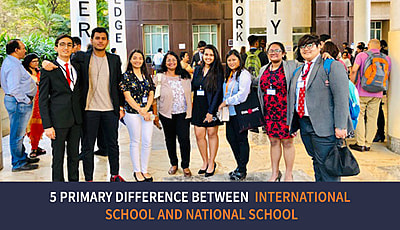
As a parent, you want your child to have an enriching learning experience with the best of facilities. The question that would naturally come to your mind is, what kind of education will be the best for your child? As international schools gain more popularity day by day, you may wonder if it is better to send your child to an international school rather than a regular national school. Therefore, it is important to understand the main differences between an international school and a national school before you make a decision. Here are a few points that explain these differences and which would help you reach an informed decision: Diversity in culture and learning: National schools generally give a great emphasis on textbook learning with a rigid syllabus. On the other hand, international schools provide a diverse and comprehensive education to their students, focusing on learning also from outside the textbooks and out of the classroom. International schools have teachers and students from different parts of the world. This provides an opportunity for the students to learn about new cultures and experiences and also learn to be more inclusive. At MIT Gurukul, we have students from both India and many overseas countries in our yearly cohorts. We also provide a variety of opportunities in sports, creative arts, other interests and regular national and international exposures through study trips, competitions and symposiums. Progression route for higher education in foreign universities and career opportunities: International schools set a curriculum that is preferred by most foreign universities. The best international schools in Pune, among which MIT Gurukul is one, provide students with better opportunities to apply and get accepted by the best universities all over the globe. These schools, most of which adopt an international curriculum such as the IB or Cambridge, make sure that their method of experiential and hands-on teaching helps the students to grow as individuals and develop a curious mind. They also provide modern facilities that foster career growth and leadership skills in the future. National schools have local or India specific curriculums that rely mostly on marks oriented outcomes and offer fewer extracurricular avenues. Interaction with teachers: International schools have a low student to teacher ratio, thus the students get individual attention and personalized mentoring on a regular basis. For example, MIT Gurukul, a top residential school in Maharashtra, is known for designing batches of smaller size. This gives ample opportunities for teachers to know each student’s strengths and weaknesses and help them strengthen the strong points and rectify the weak ones. [INSERT_ELEMENTOR id=”5216″] Learning foreign languages: Many international schools in India teach foreign languages such as German, Spanish, French, Japanese and so on. Children who learn foreign languages get to know about other cultures and can navigate their time easily as they go to study abroad. On the other hand, this kind of an opportunity is not available or limited to students studying in national schools. MIT Gurukul has a dedicated team of teachers with proficiency in teaching foreign languages on its team. Exceptional infrastructure and residential boarding: The facilities and infrastructure found in international schools are undoubtedly better than that in national schools. Since international schools are also residential schools in most instances, they have on campus student dorms that match international standards, excellent sporting facilities, dedicated technological labs, maker spaces and student study spaces. This kind of an enriched learning atmosphere helps children to learn swimming, sports, music, dance, painting, debating, and research; as well as helps them grow in their technological prowess. The buildings are also well-ventilated and the libraries have enriching books and digital journals. These schools, including MIT Gurukul, are also some of the best residential boarding schools in India that foster an environment of care, growth, learning and empathy. National schools provide many such facilities but due to limited space over which they are constructed and within the confines of a rigid curriculum they cannot match the facilities provided by international schools. This is why international schools stand out as a preferred choice for parents who want to ensure a world-class education for their children. MIT Gurukul is dedicated to providing its students the most enriching boarding school experience and the best opportunities to learn, develop and excel in every field of life. If you want to enroll your child with MIT Gurukul, we invite you to visit our campus. Please write to admissions@www.www.mitgurukul.com to fix a schedule for your campus visit.
How can empowering children help build a better world for them?

Student empowerment refers to developing strong decision-making skills so that they may make informed choices for the betterment of their academic progress, personal lives, and society. Many top schools in Mumbai and other parts of India have adopted several measures to empower their students in a variety of ways. Here are a few reasons that elucidate why student empowerment is crucial: Builds self-esteem and confidence: When children are taught to value themselves and trust their choices, they develop a strong sense of agency. They may seek help, advice or emotional support for challenging tasks or during moments of uncertainty. However, they do not rely on others all the time for every step they must take. This aids them in being confident and more independent in their lives. At MIT Gurukul, making students self-reliant and confident is the top priority. We actively encourage two-way discussions, sharing of views and ideas, and validating them through praise and encouragement. Helps better concentration and rapid learning: Empowered children realise the importance of their growth and thus are more attentive in the classroom and are mindful at home and in their general daily routines. Many international schools in Pune, one of which is the MIT Gurukul, follow this approach to help their students excel in regular learning and examinations. Positive feedback, support for giving shape and form to their independent creative ideas and showcasing their projects are ways that we deploy to motivate our students. Develops hard-working and resilient individuals: To empower students is to build a future of adults who believe in hard work rather than shortcuts. Children may face hurdles in their lives, and an empowered mind knows how to handle them with courage, resilience and intelligence. Such children do not give up in the face of obstacles, and they aim to find the right solution for the difficulties they face. MIT Gurukul finds meaningful discussions, looking at alternate solutions and helping each other as tools that work the best for our students. Now that we have discussed why empowering students is vital, here are a few ways to successfully empower them: Appreciate children when they show responsibility in their actions: When children clean their rooms, help others in their class work or complete their assigned tasks or duties, appreciate them with kind words and thoughtful gifts. This kind of positive affirmation will make them understand that they are not doing anyone else a favour but simply developing a habit of being responsible. They also feel a sense of satisfaction and joy for being dependable and trustworthy instead of fulfilling their daily responsibilities with greed or addiction to gifts. At the same time, they feel seen, valued, appreciated and empowered. Through boards displaying our student achievements, to applauding even punctuality, caring for others, leadership qualities and the spirit of teamwork, we at MIT Gurukul give our students holistic empowerment. [INSERT_ELEMENTOR id=”5216″] Teach them to make informed choices: Instead of making every decision on behalf of children, parents and teachers can present them with various options and see how they wish to proceed. One can give them a set of responsibilities from time to time and observe how they fulfill them and whether they trust their judgement. Based on their choices, they can be taught what is necessary for their growth. Use constructive criticism when required and understand what they are lacking. This will help them understand right from wrong and make informed choices. MIT Gurukul believes that success should be celebrated, and any setback should be taken as a stepping stone Thus, we gently support our students in making choices, working on them and taking ownership of them. Our students learn from any challenges that occur, and raise their confidence in the process. Participation in extracurricular activities: To empower children, we must focus on their talents and dreams. Many nursery schools in Pune, such as the MIT Gurukul, arrange creative events and talent competitions for children throughout the year. This is because when children are encouraged to participate in extracurricular activities from the very beginning of their school life, they get an opportunity to try something new. They also realise their potential, and it may help them choose the right career path in future. Instead of being another brick in the wall, student empowerment makes children aim for their personal growth and unique talents and achieve their goals in the long run. Therefore, we can conclude that student empowerment can change the lives of children for the better and shape them into confident adults who then lead future generations. To achieve this, at MIT, we encourage partnership between parents and caregivers to empower children from an early stage in life. Our open days, parent-teacher interaction events and orientations are a testimony to the same. We urge all parents to participate in them actively and share their valuable suggestions with us.
Do IB schools facilitate holistic and better learning experiences?

Children require an environment of balanced learning and interesting opportunities to help them reach their best potential. IB schools, such as the prestigious MIT Gurukul in Pune, are well-suited for this purpose because they leave no stone unturned to provide holistic and better learning experiences. Here are a few points that explain why: IB schools offer a balanced curriculum: IB syllabus schools follow a different curriculum than the rigid syllabus taught in other public and private schools of the country. The curriculum is set in such a manner that it covers a wide range of subjects, teaches students core values and at the same time, maintains an impressive balance between academics and co-curricular activities. The concepts that are introduced are well-connected and therefore, it helps the students to gain a deeper knowledge of the subjects. Their ability to analyze improves and it boosts their interest in studies and extracurricular activities. This analytical skill helps them to achieve high grades, excellent academic record and teaches them to handle ‘real life situations’ too. Opportunity to learn from highly skilled teachers: The International Baccalaureate syllabus requires teachers to be skilled and trained periodically because improvements and alterations are made to the IB curriculum quite often. The teachers provide high-quality education to students, and a lot of personal interaction is encouraged during learning. Therefore, instead of only learning facts and grasping new data daily, students are always advised to approach their instructors to clear doubts, delve more deeply into a subject of interest and develop critical thinking skills. MIT Gurukul follows this methodology of interaction between teachers and students along with a practice-based pedagogy. [INSERT_ELEMENTOR id=”5216″] A learning space filled with diversity: The top international schools in Pune and other parts of India have an environment with a lot of diversity. This is because children learn to grow and communicate better when they grow up among people from different backgrounds. They realize the importance of treating each other equally. IB schools aim to instill qualities of love, care and respect in the minds of students. They have classrooms with teachers and children from multiple cultural backgrounds. MIT Gurukul has students from more than 20 countries studying on its campus every year. They interact with each other, learn about their history and develop an interest in new languages. Moreover, the cultural awareness that IB schools like MIT Gurukul facilitate helps children to communicate effectively without feeling uneasy or hesitant. They do not fear asking questions or giving a voice to their opinion. In a global economy, this sense of confidence combined with a deep knowledge of global events and ideas prepares students for exciting opportunities and career prospects. Focus on individual talents for a holistic learning experience: Every child is unique and possesses many skills. It is important to provide students with opportunities to showcase their talents. As a result, the best schools in Pune arrange special classes and cultural programmes throughout the year. They host talent competitions where various skills are showcased, including singing, dancing, elocution, painting, and writing. These opportunities help their creative juices flow and bring them closer to their dreams. Gaming events are also planned to refresh the minds of the students, maintain fitness and develop a spirit of sportsmanship. IB schools provide wonderful chances to hone the talents of their students. Due to the diversity in culture and nationality found in such schools, different kinds of talents are showcased, and fresh ideas are introduced. During such programs, when children are busy working on their individual skills and interests, they get exposed to new skills and learn to work together in unison. These experiences help foster new friendships in the learning space and develop a better sense of coordination. Taking these points into consideration, we see that IB schools offer a balanced curriculum not only for academic learning but also for the overall growth of their students. Therefore, they undoubtedly facilitate holistic and better learning experiences which help their students excel in life. To know about the details of our curriculum and our teaching methodology, plus other ways in which we enrich our students’ learning, please visit our website at https://www.mitgurukul.com/