

What Makes IB Residential Schools in Pune Stand Out?
If you’ve never sent a child away to board before, your real question about IB residential schools in Pune probably isn’t about rankings; it’s simpler than that: what does a day actually look like once your child moves onto campus? That’s the question this piece answers, section by section, rather than listing features in the abstract.
A Typical Day, Not a Marketing Timeline
Life inside International Residential Schools in Pune runs on a structured rhythm that balances academics with everything happening outside the classroom. It’s worth picturing it concretely rather than in general terms, because the daily rhythm is what your child actually experiences, not the mission statement on the website:
- Morning academic blocks built around IB’s inquiry-based teaching
- Afternoons split between sports, performing arts, or STEM and innovation labs
- Supervised evening study sessions with access to house parents or mentors
- Weekend enrichment, clubs, competitions, or community-service projects
What Boarding Actually Adds Beyond the Classroom
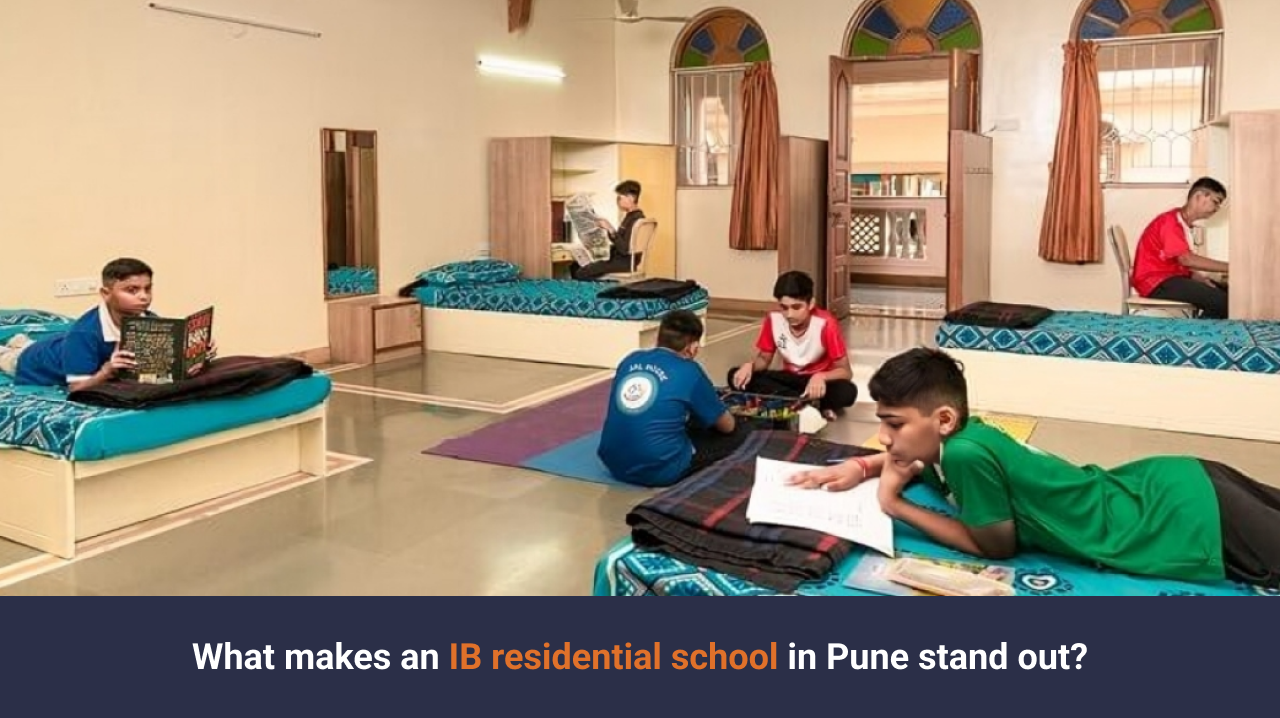
The residential piece isn’t accommodation bolted onto a school day. At well-run best IB residential schools in Pune, pastoral care is treated as seriously as academics:
- Dedicated house parents responsible for a small group of students
- On-campus health and wellness support, including counselling
- Structured mentoring that tracks a student’s development, not just grades
- A built-in peer community spanning dozens of cultural and geographic backgrounds
None of this works without consistency, though. Ask specifically how often house parents rotate, because a revolving cast of supervisors undermines the mentoring relationships that make boarding valuable in the first place. A child who sees the same trusted adult daily tends to settle in faster and communicate concerns earlier than one navigating an inconsistent structure.
How This Differs From a Traditional Boarding School
| Parameter | IB Residential Schools | Traditional Boarding Schools |
| Curriculum | International Baccalaureate | National board (CBSE/ICSE/State) |
| Learning Style | Inquiry-based | Teacher-centred |
| Assessment | Projects, continuous evaluation | Periodic exams |
| Residential Focus | Structured mentoring plus accommodation | Primarily accommodation |
| Skill Development | Critical thinking, leadership, communication | Largely academic knowledge |
The gap is most evident in how a school spends its residential hours. A traditional boarding house treats evenings largely as supervised prep time; a well-run IB residential setup treats those same hours as an extension of the school’s learning philosophy, reflection, reading, or collaborative project work rather than silent study alone.
What the Research Actually Shows
The claim that boarding supports “holistic development” is easy to make but harder to back up, yet there is real evidence to support it. A widely cited meta-analysis published in Child Development, covering more than 270,000 students across 213 school-based social-and-emotional learning programmes, found an 11-percentile-point gain in academic achievement among participants compared with those who didn’t take part. That’s the mechanism structured pastoral care is designed to activate: social and emotional skill-building that shows up later as measurable academic gains, not just anecdotal confidence.
This matters more in a residential setting than in a day-school setting, simply because there are more daily touchpoints for that skill-building to occur. A shared meal, a resolved roommate disagreement, a coached response to homesickness, rather than a once-a-week counselling slot squeezed into a day-school timetable.
Choosing the Right Fit for Your Child
Before shortlisting IB residential schools near Pune, ask about specifics rather than atmosphere: IB authorisation status, the actual student-to-house-parent ratio, medical facilities on site, and how the school communicates with parents once your child is on campus full-time. Boarding suits some children far more than others, and the honest answer to whether it suits yours usually comes from a campus visit, not a brochure. Independent, curious children tend to adjust quickly; children who need more one-on-one reassurance may need a longer settling-in period, and a good school will say so plainly rather than reassuring you that every child adapts at the same pace.
MIT Vishwashanti Gurukul World School offers a useful reference point here: a 125-acre residential campus in Loni Kalbhor housing over 700 students from more than 30 countries across the full PYP-to-DP continuum, with separate, secured boarding houses for boys and girls. Whether or not it’s the right fit for your family, it’s a fair benchmark to measure other schools against.