

Think back to your own school days. Which lessons do you actually remember? Chances are, it wasn’t the ones where you sat quietly copying notes from a blackboard. It was the science experiment that went unexpectedly wrong, the debate where you had to argue a side you disagreed with, or the field trip that brought a chapter in your textbook to vivid life. That is experiential learning in schools at its most powerful, and it has been shaping how children truly learn for decades.
As parents and educators begin to question the limits of rote memorisation, there is a growing recognition that children need more than the ability to recall facts. They need the confidence to apply knowledge, solve problems, collaborate with peers, and adapt to an ever-changing world.
This guide walks you through what experiential learning in schools really means, why it matters, and how it can be thoughtfully woven into a child’s educational journey.
What Is Experiential Learning, and Why Does It Matter in Schools?
Experiential learning is a teaching approach where students gain knowledge and skills through direct experience and reflection, rather than passive instruction. The concept was formalised by education theorist David Kolb, whose learning cycle describes a four-stage process:
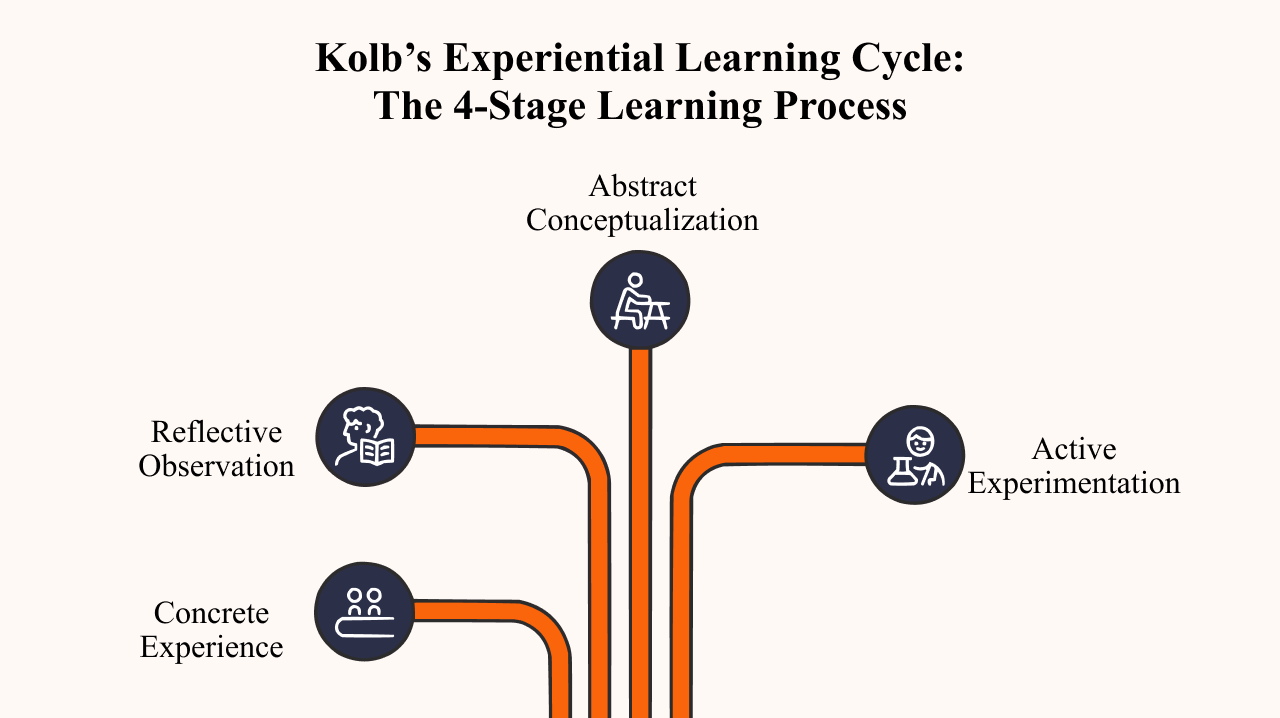
- concrete experience
- reflective observation
- abstract conceptualization
- active experimentation
In simple terms, students do something, think about what happened, draw conclusions, and then test those conclusions in new situations.
The importance of experiential learning in schools lies in how it mirrors the way the human brain is wired to learn. Research consistently shows that people retain approximately 75% of what they learn by doing, compared to just 5% from lectures alone. For children navigating a complex, skills-driven world, this difference in retention and application is significant.
How Does Experiential Learning Differ from Traditional Classroom Teaching?
It helps to see the two approaches side by side. Traditional teaching places the teacher at the centre, with students as recipients of information. Experiential learning flips this dynamic; the student becomes the active participant, and the teacher becomes a facilitator and guide.
| Aspect | Traditional Teaching | Experiential Learning |
| Student Role | Passive listener | Active participant |
| Focus | Memorisation of facts | Application and reflection |
| Assessment | Exams and tests | Projects, portfolios, presentations |
| Teacher Role | Authority and lecturer | Mentor and guide |
| Real-world Connection | Limited | Central to learning |
This shift is what makes real-life learning in education so compelling. When a student studies ecosystems by planting a school garden rather than reading a diagram, the learning is richer, more memorable, and far more connected to the real world.
You can read more about this approach in our detailed piece on the real-life application of education.
What Are the Key Benefits of Hands-On Learning for Students?
The case for experiential learning goes well beyond better exam results. Here is what research and classroom practice consistently show:
- Deeper understanding: When students engage with material through doing, they develop conceptual clarity that textbooks rarely provide on their own.
- Stronger critical thinking: Hands-on tasks require students to question assumptions, analyse outcomes, and revise thinking, skills that are at the core of 21st-century readiness.
- Greater motivation and engagement: Active participation is inherently more engaging. Students who enjoy what they are doing are more likely to persist, ask questions, and connect ideas.
- Development of social skills: Many experiential activities involve collaboration, communication, and shared problem-solving, building the interpersonal skills children will use throughout life.
- Improved self-confidence: Successfully completing a real-world challenge, whether a community project or a science investigation, builds a child’s belief in their own abilities.
These experiential learning benefits extend far beyond academic performance. A child who learns to cook a recipe from scratch, manage a school stall, or build a working model is also learning budgeting, time management, communication, and resilience. This is what a holistic education approach truly looks like in practice.
Our guide on holistic education and developing leaders beyond classrooms explores this connection in greater depth.
What Are Some Examples of Experiential Learning Activities in Schools?
One of the most common questions parents ask is: what does this actually look like in a school setting? The answer varies by age group and subject, but the principle remains consistent across all of them.
| Subject Area | Activity | Skill Developed |
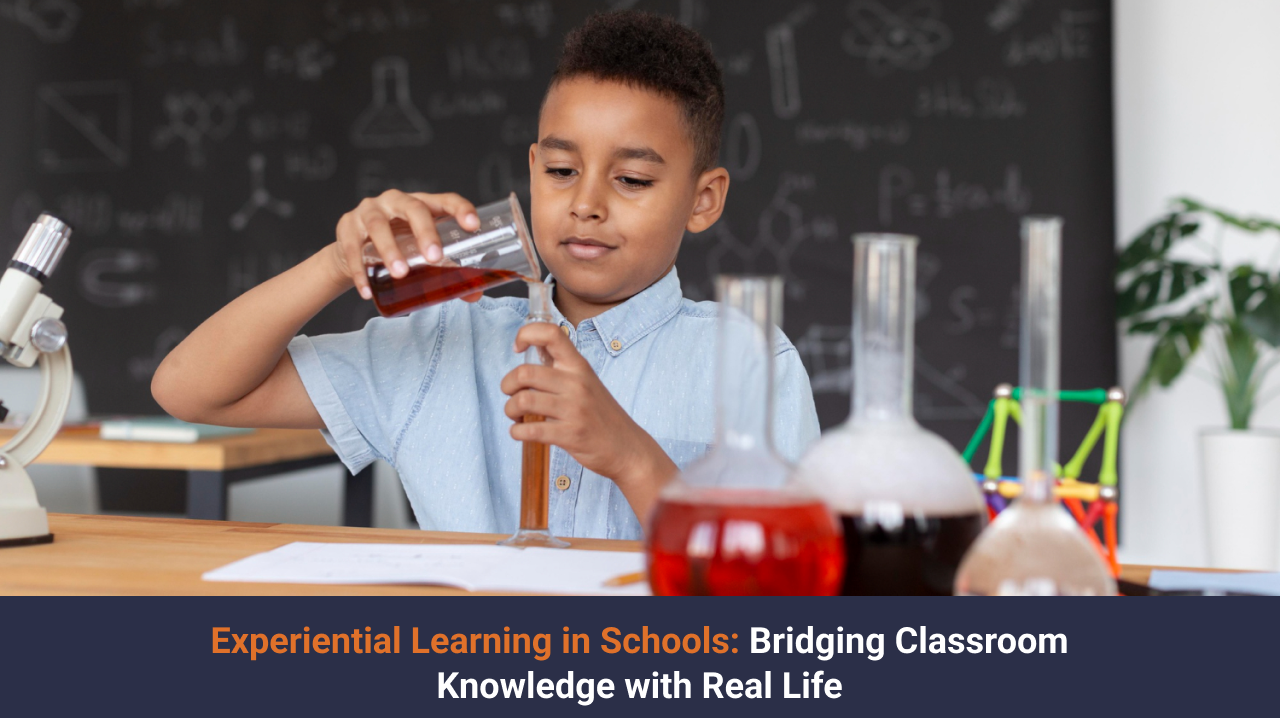
| Science | Conducting experiments and field investigations | Inquiry, observation, analysis |
| Mathematics | Running a mock market stall | Numeracy, budgeting, decision-making |
| Social Studies | Community heritage walks or interviews with elders | Empathy, research, cultural awareness |
| Language Arts | Debates, storytelling, and public speaking | Communication, confidence, persuasion |
| Environmental Studies | School garden or composting project | Responsibility, ecology, teamwork |
| Arts and Culture | Theatre, visual art installations, and music performance | Creativity, self-expression, discipline |
These examples of experiential learning activities illustrate that the approach is not a single method. It is a philosophy of learning that can be applied across every subject and every age group. The key is that the student is always at the centre, actively engaged with an authentic task that connects to the wider world.
How Can Schools and Parents Support Experiential Learning at Home and Beyond?
Experiential learning does not have to stop at the school gate. Parents play a meaningful role in extending and reinforcing these experiences. Here are some practical ways to support your child:
- Involve children in household tasks such as cooking, budgeting, or planning a trip, framing them as learning opportunities.
- Encourage curiosity through questions rather than answers. Ask “what do you think would happen if…” rather than providing solutions immediately.
- Visit museums, nature reserves, community events, and cultural spaces. These informal learning environments are invaluable.
- Allow children to fail and recover. Resilience is built through navigating real challenges, not avoiding them.
- Discuss current events, local issues, and global topics as a family. This connects classroom learning to the world beyond it.
Schools, for their part, can use experiential learning in schools more consistently by training teachers in facilitation rather than instruction, building partnerships with local organisations and businesses, designing assessments that reward applied thinking, and ensuring that digital tools serve learning rather than replace it.
It is also worth considering how social media can be used thoughtfully in education to connect students with broader communities and real-world projects.
Which Curriculum Frameworks Best Support Experiential Learning?
Not all curricula are equally designed for experiential approaches, but some frameworks stand out for their commitment to practical education benefits and student-centred learning.
The International Baccalaureate (IB) curriculum, for instance, is built around inquiry, action, and reflection. Its programmes at every level require students to apply learning across real-world contexts, undertake community service, and complete independent research or creative projects.
The IB’s Creativity, Activity, Service (CAS) component at the Diploma level is a direct embodiment of experiential principles: students do not just learn about global citizenship; they practise it.
For parents considering the IB pathway, it is worth understanding how this prepares students not only for universities around the world but also for the realities of adult life.
Our guide on study abroad advising explores how an experiential, IB-based education equips students for global opportunities
What Does Real-Life Learning in Education Look Like at MIT Gurukul?
At MIT Gurukul, an IB school in Pune, real-life learning in education is woven into every aspect of school life. From collaborative science investigations and community outreach programmes to student-led exhibitions and culturally rooted Indian values projects, students are given consistent opportunities to learn by engaging with the world around them.
For families seeking an education that is genuinely holistic, internationally rigorous, and grounded in Indian cultural values, MIT Gurukul represents that rare combination where curriculum, community, and character development come together.
Frequently Asked Questions
1. What is the meaning of experiential learning in the context of school education?
Experiential learning refers to a method of teaching where students gain knowledge and skills through direct experience, reflection, and application, rather than through passive listening or memorisation. In schools, this can take many forms, from science experiments and role-plays to community projects and field investigations.
2. How is experiential learning different from project-based learning?
While the two overlap, project-based learning is one type of experiential learning. Experiential learning is a broader philosophy that includes any form of active, reflective engagement with the real world. Project-based learning is a structured method within that broader approach.
3. At what age should experiential learning begin?
From the earliest years. Research and India’s NEP 2020 both indicate that experiential approaches are most powerful when introduced early, through play-based learning in the foundational years, and then progressively deepened through structured activities as students grow.