


Top 5 Elements of Primary Years Program

It is said that a strong foundation makes a strong building. Similarly, for any child, the primary years at school make the foundation for their entire further education. Thus it is important to enrol your child in a curriculum and pedagogy that help them lay a strong foundation. The IB Primary Years Program, commonly known as the PYP, is curated to provide a balance in learning for students. In order to achieve this balance, it focuses on the five parts of the curriculum that are known as the Essential Elements of the PYP curriculum. These five elements of the International Baccalaureate PYP are: Knowledge: Trans-disciplinary themes are inculcated in the IB PYP syllabus to make students gain in-depth knowledge of the concepts they learn. With the help of these concepts, they not only understand their subjects or disciplines but also find intelligent ways to approach real-life situations. Students also get to understand: What their identity is How they may express themselves How the real world functions How to organise and manage their time Both the processes of teaching and learning gain importance, authenticity and relevance when the curriculum wisely blends science, literature, mathematics, social studies and other areas of knowledge. At MIT Gurukul, one of the best IB residential boarding schools in India, your child will learn these themes in detail according to their age, grade and stage. This forms a strong knowledge base in their minds and helps them in their journey of growth and development. Concepts: The Primary Years Program is based on concepts which encourage students to be curious, ask questions and want to learn more on a subject. The eight key concepts include: Form: What is it like? Function: How does it work or function? Causation: What has caused it to be this way? What is the reason behind this? Change: How is it changing with time? Connection: How is it connected or linked to other things? What is their relationship? Perspective: What is the viewpoint on it? Responsibility: What is our responsibility regarding it? Reflection: How do we know this? Schools such as MIT Gurukul encourage their students and teachers to use these concepts to form new questions, widen their perspectives and focus on a broader level. This also helps students to learn more about any subject or area of the curriculum that they find interesting. Skills: The five multifaceted skills which students learn through the PYP curriculum are: Thinking skills Research skills Self-management skills Communication skills Social skills With this set of skills, a child can soar high and build a bright future full of opportunities both within academics and in real life. Therefore, it is crucial to be aware of these skills, acquire them and apply them to achieve them. Attitudes: Honing the right attitude and refining one’s aptitude are important factors that lead to leadership and communication development. The PYP curriculum includes training and mentoring aspects that aid the development of these qualities. It teaches students to be: Mindful in daily activities Great communicators Caring towards parents, teachers, peers and others Risk-takers for continuous improvement These attitudes help students throughout their lives by building remarkable character and making them socially conscious. Action: The PYP curriculum also aims to balance learning and transfer it to actionable outputs so students can reflect upon what they imbibe and make informed choices. Their positive actions inspire their classmates, school staff and the larger community. In order to achieve this, it is advised that a positive attitude in the learning space should be maintained. New challenges foster growth, creative skill building and active participation in communities. IB schools in India, such as MIT Gurukul, bring the best out of the Primary Years Program and help facilitate the development of socially beneficial actions in the students. Focusing on these crucial five elements of the Primary Years Program, MIT Gurukul ensures your child receives the best opportunities to learn and reach new heights. If you are interested in enrolling your child in our school, you may write to admissions@www.www.mitgurukul.com to fix a schedule for your campus visit to understand the quality of learning we offer. [INSERT_ELEMENTOR id=”5216″]
How do children learn in IB PYP?

The IB Primary Years Program (PYP) is a balanced international curriculum for children who are 3 to 12 years old. Offered by the International Baccalaureate Organization (IBO), the IB PYP curriculum follows a rigorous interdisciplinary approach. The overall purpose of the PYP curriculum is to: Encourage students to think critically Make them aware of local and global issues Help them explore the best of opportunities in life If you are a parent who is wondering whether you should choose a school that offers an IB Early Years Program for your child, you need to first understand the impact of such a curriculum. Here are a few points that discuss the impact of the IB PYP curriculum on students: Recognized all over the globe: One of the reasons why IB schools are getting more popular with time is that their syllabus is preferred by international universities. The International Baccalaureate diploma has great significance, and it opens doors to multiple opportunities. In IB schools, among which MIT Gurukul is one, you can be assured that your child will receive the best quality of education that will help them throughout their life. If you want your child to pursue higher education in the highest ranked universities abroad, the PYP curriculum will get them one step ahead of the game by laying a strong early academic foundation. Research-based curriculum: The curriculum and teaching methodology are based on research outcomes. Teachers who teach in these schools are provided thorough professional training from time to time to maintain the best quality of education as per the evolving needs and curriculum design. Such a curriculum is also standardised, meaning it is easier for children to adapt to the transition in their learning if their parents have transferable jobs. Better learners and thinkers: Children who learn under the IB PYP system are better in the following fields as compared to children who study in national regular schools: Reading abilities Math based problem-solving Narrative writing and critical analysis of written matter Current affairs Real-life applications of knowledge [INSERT_ELEMENTOR id=”5216″] They also interact with their teachers in small groups and individually often and get personalised attention. This helps them to learn more rapidly, develop an attentive mind and think critically when they approach a subject. A joyful learning experience: Nowadays, only academic merit is not enough for a successful future. Parents want their children to also develop soft skills and explore other activities that they are interested in. IB schools take great care of that aspect by focusing not only on the best academic learning but also on the best kind of overall growth for every child. For example, at MIT Gurukul, one of the best IB boarding schools in India, children are encouraged to participate in activities that help them nurture their talents. An environment of joy, care, empathy and adventure is created to make children feel inspired to learn every day from a young age. Therefore, due to the best academic curriculum and the focus on the overall growth of children, IB schools are ideal for children to develop their overall personality within a stimulating study environment. At MIT Gurukul, we ensure that your child gets every opportunity to learn, think and grow. We teach them to keep an open mind, create balance in their daily lives and reflect on their thoughts and actions. We help them experience a joyful learning experience and also prepare them for the 21st-century world that is tech-enabled and full of new opportunities. If you want your child to study at MIT Gurukul, we invite you to visit our campus to understand the kind of education and values we impart even in our PYP program. Please write to admissions@www.www.mitgurukul.com to fix a schedule for your campus visit.
5 Primary difference between International School and National School
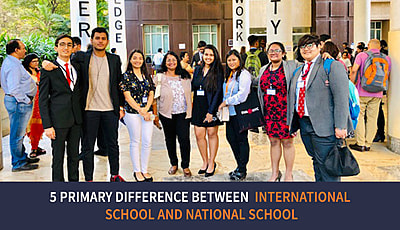
As a parent, you want your child to have an enriching learning experience with the best of facilities. The question that would naturally come to your mind is, what kind of education will be the best for your child? As international schools gain more popularity day by day, you may wonder if it is better to send your child to an international school rather than a regular national school. Therefore, it is important to understand the main differences between an international school and a national school before you make a decision. Here are a few points that explain these differences and which would help you reach an informed decision: Diversity in culture and learning: National schools generally give a great emphasis on textbook learning with a rigid syllabus. On the other hand, international schools provide a diverse and comprehensive education to their students, focusing on learning also from outside the textbooks and out of the classroom. International schools have teachers and students from different parts of the world. This provides an opportunity for the students to learn about new cultures and experiences and also learn to be more inclusive. At MIT Gurukul, we have students from both India and many overseas countries in our yearly cohorts. We also provide a variety of opportunities in sports, creative arts, other interests and regular national and international exposures through study trips, competitions and symposiums. Progression route for higher education in foreign universities and career opportunities: International schools set a curriculum that is preferred by most foreign universities. The best international schools in Pune, among which MIT Gurukul is one, provide students with better opportunities to apply and get accepted by the best universities all over the globe. These schools, most of which adopt an international curriculum such as the IB or Cambridge, make sure that their method of experiential and hands-on teaching helps the students to grow as individuals and develop a curious mind. They also provide modern facilities that foster career growth and leadership skills in the future. National schools have local or India specific curriculums that rely mostly on marks oriented outcomes and offer fewer extracurricular avenues. Interaction with teachers: International schools have a low student to teacher ratio, thus the students get individual attention and personalized mentoring on a regular basis. For example, MIT Gurukul, a top residential school in Maharashtra, is known for designing batches of smaller size. This gives ample opportunities for teachers to know each student’s strengths and weaknesses and help them strengthen the strong points and rectify the weak ones. [INSERT_ELEMENTOR id=”5216″] Learning foreign languages: Many international schools in India teach foreign languages such as German, Spanish, French, Japanese and so on. Children who learn foreign languages get to know about other cultures and can navigate their time easily as they go to study abroad. On the other hand, this kind of an opportunity is not available or limited to students studying in national schools. MIT Gurukul has a dedicated team of teachers with proficiency in teaching foreign languages on its team. Exceptional infrastructure and residential boarding: The facilities and infrastructure found in international schools are undoubtedly better than that in national schools. Since international schools are also residential schools in most instances, they have on campus student dorms that match international standards, excellent sporting facilities, dedicated technological labs, maker spaces and student study spaces. This kind of an enriched learning atmosphere helps children to learn swimming, sports, music, dance, painting, debating, and research; as well as helps them grow in their technological prowess. The buildings are also well-ventilated and the libraries have enriching books and digital journals. These schools, including MIT Gurukul, are also some of the best residential boarding schools in India that foster an environment of care, growth, learning and empathy. National schools provide many such facilities but due to limited space over which they are constructed and within the confines of a rigid curriculum they cannot match the facilities provided by international schools. This is why international schools stand out as a preferred choice for parents who want to ensure a world-class education for their children. MIT Gurukul is dedicated to providing its students the most enriching boarding school experience and the best opportunities to learn, develop and excel in every field of life. If you want to enroll your child with MIT Gurukul, we invite you to visit our campus. Please write to admissions@www.www.mitgurukul.com to fix a schedule for your campus visit.