

If you are a parent searching for the right primary school in Pune, you are probably thinking about a lot more than textbooks and test scores. You want a school where your child grows, discovers their passions, makes friends, and learns to navigate the world with confidence.
Today’s most thoughtful parents look for schools that nurture creativity, leadership, sportsmanship, communication, and emotional well-being alongside academic excellence. Pune has evolved into a city with a rich education landscape, and many leading schools now offer strong extracurricular ecosystems spanning sports, arts, music, dance, robotics, theatre, and leadership activities.
Extracurricular participation helps children build confidence, teamwork, discipline, and critical thinking from an early age. If you are comparing options and want your child to get a truly well-rounded education, this guide is for you.
Why Are Extracurricular Activities Important in Primary Education?
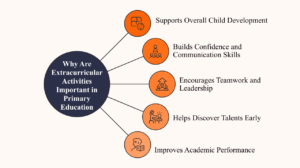
- Supports Overall Child Development: Activities beyond academics improve social, emotional, physical, and creative growth simultaneously. A child who paints, plays football, and acts in a school play is developing far more dimensions than one who only studies.
- Builds Confidence and Communication Skills: Participation in debates, performances, and competitions enhances self-expression. Children learn to articulate their thoughts, manage nerves, and speak with clarity.
- Encourages Teamwork and Leadership: Sports and collaborative projects teach responsibility and cooperation. These are life skills that no textbook can fully deliver.
- Helps Discover Talents Early: Children get opportunities to explore music, art, dance, coding, and athletics before they are locked into academic tracks. Early exposure can shape a lifetime.
- Improves Academic Performance: Studies show that balanced co-curricular activities in schools positively impact concentration and learning outcomes. A study conducted in Lucknow, Uttar Pradesh, published in the International Journal of Sociology and Anthropology Research found that all six types of extracurricular activities, including sports, dance, and music, significantly improved student performance in both government and private schools.
What Features Should You Look for in Primary Schools With Strong Extracurricular Programs?
When evaluating schools, look for these clear markers of a genuinely strong extracurricular culture:
- Dedicated sports infrastructure and trained coaches
- Music, dance, theatre, and visual arts programmes
- STEM, robotics, and innovation clubs
- Opportunities for public speaking and leadership development
- Inter-school competitions and cultural events
- A holistic curriculum that integrates academics with co-curricular learning
These features separate schools that simply list activities on a brochure from schools that build them into daily student life.
How Does the Comparison Look Across Different School Types in Pune?
| Parameter | Schools With Strong Extracurricular Programmes | Traditional Academic-Focused Schools | International Primary Schools Pune |
| Learning Approach | Holistic and activity-based | Primarily academic-focused | Inquiry and experiential learning |
| Sports Exposure | Extensive | Moderate | Strong |
| Arts & Creativity | High emphasis | Limited | Strong |
| STEM Activities | Robotics, coding, innovation labs | Basic exposure | Advanced integration |
| Student Confidence Building | Strong focus | Moderate | Strong |
When looking for the best primary schools in Pune, this table makes clear that schools with a genuine extracurricular commitment produce more well-rounded, confident learners.
How Do Extracurricular Programmes Benefit Children in the Early Years?
- Improved Academic Performance
Research consistently shows a positive link between extracurricular involvement and academic results. India’s NEP 2020 has explicitly called for no rigid separation between curricular and extracurricular activities, recognising this connection at the highest policy level.
- Better Emotional Development
Participation in arts and sports builds emotional resilience and social confidence. Children who perform on stage, lead a team, or create something original develop a stronger sense of self and learn to handle both success and setbacks with maturity.
- Higher Physical Fitness Levels
This matters urgently. According to the WHO Physical Activity Factsheet 2024 for India, 74% of children and adolescents aged 11 to 17 in India are insufficiently physically active. Schools that embed structured sports into their programmes give children a critical head start in building healthy, active habits before inactivity takes hold.
- Enhanced Creativity and Problem-Solving
Creative activities and innovation programmes strengthen critical thinking and imagination. Children who work on robotics challenges, stage productions, or art projects learn to approach problems from multiple angles, a skill that stays with them far beyond school.
Schools that prioritise co-curricular activities in schools alongside rigorous academics, as the best primary schools in Pune increasingly do, are giving their students a meaningful advantage in life.
At MIT Gurukul, we believe every child deserves more than a classroom. Our IB curriculum blends academic rigour with rich extracurricular programmes spanning sports, arts, robotics, music, and leadership.
Give your child the foundation they deserve. Visit our website or book a school tour today at www.mitgurukul.com.
Frequently Asked Questions
1.What extracurricular activities should a good primary school offer?
A well-rounded school should offer sports with trained coaches, performing arts such as music, dance, and theatre, STEM and robotics clubs, visual arts, and platforms for public speaking and leadership. Variety matters so every child can find something that excites them.
2. Why are extracurricular activities important for primary school students?
They support holistic development by building confidence, teamwork, creativity, and resilience. They also improve focus and academic performance over time in ways that classroom learning alone cannot achieve.
3. Are international primary schools in Pune better for holistic development?
International schools often integrate inquiry-based and experiential learning with strong extracurricular frameworks. Schools like MIT Gurukul blend the IB curriculum with Indian values, offering a globally relevant yet culturally grounded education for every child.
4. How can parents evaluate a school’s extracurricular programmes?
Visit the school in person, observe the facilities, speak to existing parents, and ask specific questions about coach qualifications, event calendars, and how activities are woven into the weekly timetable rather than treated as optional extras.