

Think about the skills your child will truly need to navigate the world, not just in school, but in life. The ability to express how they feel, work alongside others, bounce back from setbacks, and connect with people meaningfully. These are the skills that shape confident, capable human beings.
Today’s parents understand this. That is why international primary schools in Pune are drawing so much attention. These schools actively nurture emotional intelligence, communication, empathy, and resilience, alongside strong academics. Children who feel secure and understood are children who learn better, too.
Young learners today need collaboration, adaptability, and resilience to thrive in a rapidly changing world. And the good news is, the right school environment can build all of this from the very start.
What Is Social and Emotional Development in Early Childhood?
Social and emotional development (SEL) in early childhood refers to a set of foundational abilities every child builds from their earliest years:
- A child’s ability to understand and manage emotions effectively
- Building healthy relationships with peers, teachers, and family members
- Developing self-confidence, empathy, communication, and teamwork
- Practising problem-solving, decision-making, and conflict-resolution skills
- Laying the groundwork for academic success and overall well-being
These skills need to be deliberately nurtured through the right learning environment, which is precisely where international schools make a real difference.
How Do International Primary Schools in Pune Encourage Social and Emotional Learning?
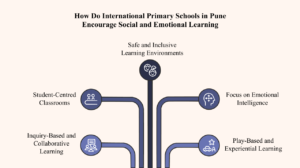
Schools following globally recognised frameworks like the IB (International Baccalaureate) embed SEL into everyday learning, naturally and consistently.
- Inquiry-Based and Collaborative Learning: Children work on group projects and discussions that build real communication and teamwork skills. They learn to listen, negotiate, and share ideas with confidence.
- Student-Centred Classrooms: Teachers pay close attention to each child’s emotional and developmental needs. Active participation is encouraged, and no child is left feeling invisible.
- Safe and Inclusive Learning Environments: International schools in Pune build spaces where every child feels respected, valued, and comfortable expressing themselves freely.
- Focus on Emotional Intelligence: Young learners are guided to name their emotions, manage their feelings, and show empathy towards others. This is taught as deliberately as maths or literacy.
- Play-Based and Experiential Learning: Through storytelling, role-play, art, and outdoor activities, children express their inner worlds and develop social skills in natural, joyful ways.
How Do International Primary Schools Compare with Traditional Schooling in Supporting Emotional Development?
| Parameter | International Primary Schools | Traditional Schooling | Other School Systems |
| Learning Environment | Student-centric and interactive | Teacher-led | Mixed approach |
| Emotional Development | Strong focus on SEL | Limited emphasis | Moderate |
| Communication Skills | Encouraged through collaboration | Less interactive | Balanced |
| Classroom Culture | Inclusive and supportive | Structured and formal | Moderate |
| Assessment Style | Observation and continuous feedback | Exams and tests | Mixed |
Why Is Social and Emotional Development Important for Young Learners?
- Early Childhood Shapes Emotional Growth
85% of brain development before age 6. India’s NEP 2020 recognises that over 85% of a child’s brain development occurs before age six, making the early years the most critical window for building emotional development in early childhood. What children learn in these years shapes their confidence and social behaviour for life.
- Impact on Academic Performance
A survey of 55 schools across two Indian states found that 85% of children who received structured SEL showed improvement in social and emotional skills, while classroom curiosity, participation, and collaboration also rose sharply, directly boosting academic performance. This shows that mental health and wellbeing in schools and academic results go hand in hand.
- Development of Future-Ready Skills
Global employers consistently rank communication, collaboration, empathy, and adaptability among the most essential workforce skills. Children who build these early carry a real advantage into every stage of life.
- Mental and Emotional Well-Being
Children who learn to manage emotions from a young age are better equipped to handle stress, peer interactions, and challenges. Mental health and wellbeing in schools begins in the primary years, and those foundations stay with a child for life.
Frequently Asked Questions
- What is social and emotional learning (SEL) in primary education?
SEL in primary education refers to the process through which children develop self-awareness, empathy, emotional regulation, communication, and relationship skills. In international schools, these are taught through daily activities, collaborative projects, and reflective practices.
- How do international primary schools in Pune help children build confidence?
Through student-centred classrooms, inclusive environments, and regular opportunities to present, collaborate, and lead, children gradually build a secure sense of self. Being heard and valued in school makes a significant difference.
- Why is emotional development important in early childhood?
Emotional development in early childhood forms the foundation for how children handle relationships, learning challenges, and stress throughout life. Strong early emotional foundations lead to better academic outcomes and greater resilience.
- How does the IB Primary Years Programme support social skills?
The IB PYP uses inquiry-based learning, transdisciplinary projects, and learner profiles that include attributes like being caring, open-minded, and principled. These naturally build social skills and emotional intelligence through every subject and every interaction.
At MIT Gurukul, we believe that nurturing the whole child is the very heart of education. Our IB framework, experienced educators, and vibrant residential community come together to support every young learner’s academic, social, and emotional growth.
If you are looking for international primary schools in Pune that genuinely invest in who your child is becoming, we would love to welcome you.