

Introduction
Modern education is no longer oriented towards memorising facts and reproducing them in an examination hall. The world needs thinkers, innovators, and problem-solvers. For this reason, most IB board schools in Pune have subscribed to international teaching philosophies that place more emphasis on understanding rather than repetition. One of the most ardent supporters of such a change is the International Baccalaureate. Its teaching methodology is based on inquiry, reflection, and curiosity. In schools like MIT Gurukul, learning is not merely about textbooks; instead, it involves growing up to be thoughtful and independent. This was all in preparation for a clear comparison between inquiry-based learning benefits and traditional rote learning.
What is inquiry-based learning in IB?
IBL is a student-centred approach where students learn by questioning, investigating problems, and reflecting upon their findings. Students in this model are not provided with answers but are encouraged to seek out information, test ideas, and draw conclusions. The elements that comprise IBL are questioning, exploring, experimenting, and reflecting. This model reinforces the critical thinking in the IB curriculum, whereby the students apply interrelated ideas, question assumptions, and create a deeper understanding when they apply the concepts to real-life situations. This aligns with the National Education Policy (NEP 2020) recommendations, which encourage Indian schools to replace rote learning with activity-, discussion- and analysis-based classroom experiences.
Comprehending Traditional Rote Learning
It is a technique that relies heavily on repeating and committing to memory. Students are obliged to memorise the information and then furnish the same text during the tests. Apart from serving short-term recall, this rarely encourages genuine understanding. Conventional schools continue to depend on rote learning because it is structured, predictable, and much easier to measure than other teaching techniques. But it often restricts creativity, and does not eventually prepare students for solving real-life problems or analytical tasks outside of the classroom.
Key differences between IBL and Rote Learning
- IBL has an exploratory learning process, whereas rote learning is repetitive.
- The student’s participation in IBL is active, while it is by and large passive in the case of rote learning.
- In IBL, assessment is done on the basis of application and understanding, whereas in rote learning, it is memory that is evaluated.
- The skill development in IBL comprises communication, collaboration, and analysis, while in rote learning, it is just recall that gets developed.
- Long-term retention is stronger in IBL because students understand concepts. Motivation is naturally higher in IBL since curiosity drives the learning there.
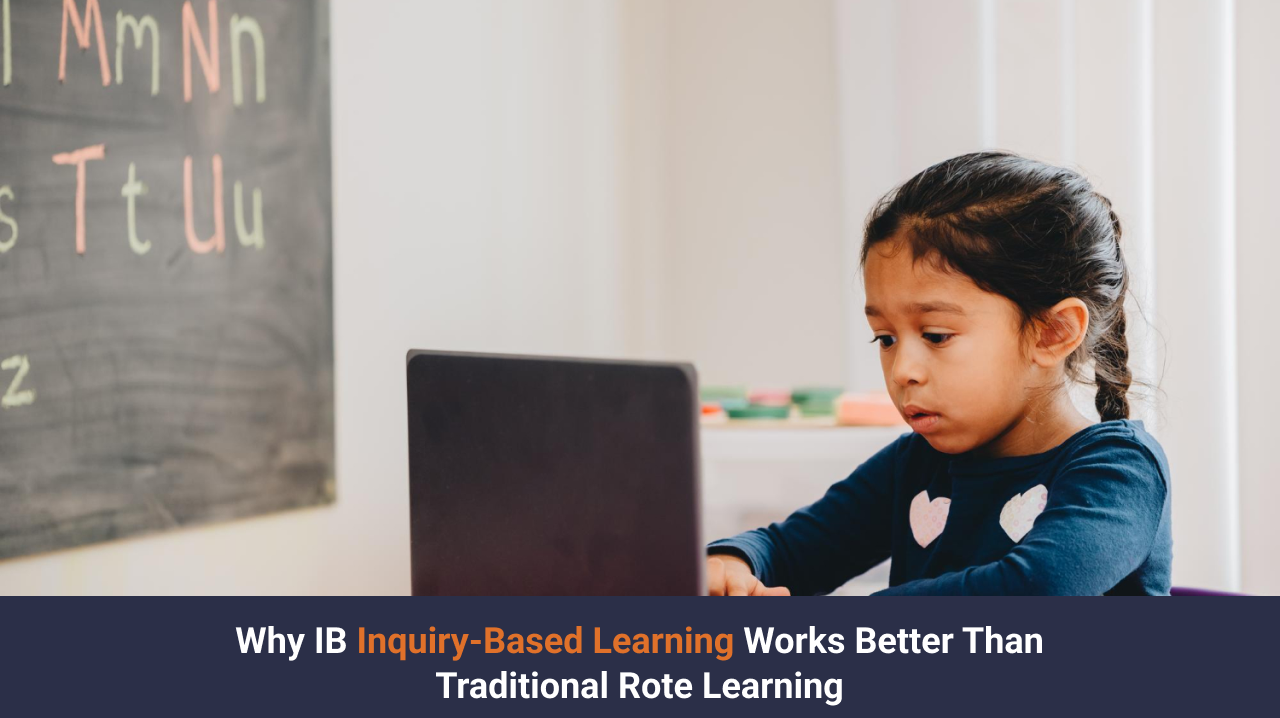
Why IB Inquiry-Based Learning Works Better
It trains independent thinkers who can dissect complex problems and offer solutions through inquiry-based learning, thereby developing the essential problem-solving capacity for the real world by fostering conceptual understanding instead of superficial memorisation. Projects, discussions, and practical experiences further enhance communication, collaboration, and research skills among the students. They learn in an enjoyable, relevant, and engaging manner. With all this comes discipline, resilience, and a love for lifelong learning over time. The long-term inquiry-based learning benefits acquired through IB prepare students for higher education and even professional life thereafter. Little wonder that more parents in IB board schools Pune choose the IB for globally relevant education.
Conclusion
Traditional rote learning may have its place in revision, but it does not meet the requirements of today’s world. MIT Gurukul differentiates itself from others by completely accepting the IB inquiry-based method, which is characterised by questioning, exploring and innovating in the process of learning. Our provision of first-class facilities, highly skilled teachers and a well-rounded emphasis on studies, artistic expression and morals guarantees comprehensive growth of the child. We nurture students with self-assurance, lucidity and analytical skills that are of utmost importance for winning in life. For more information, visit our official website.
FAQ’s
1. What is inquiry-based learning in the IB curriculum?
Inquiry-based learning is a teaching approach where students learn by asking questions rather than memorising answers. They explore topics through research, discussion, and real-world problem-solving. Over time, this builds independent thinking and a genuine curiosity that stays well beyond the classroom.
2. How does the IB curriculum encourage critical thinking?
Lessons are designed around real-world problems rather than fixed textbook content. Students analyse, question, and draw their own conclusions through debates and research projects. Assessments measure how a student thinks, not just what they recall.
3. Are IB schools better than traditional schools for holistic development?
IB schools assess students across multiple dimensions, including academics, personal and social growth, and community contribution. Traditional schools tend to prioritise exam performance. The IB framework formally includes service projects and extracurricular engagement, making personal development a structured part of every student’s education.