

Introduction
If you’ve ever witnessed a preschooler playing, you will see how often they ask, “Why?” or “How?” Whether humorous or strikingly profound, their little worlds are full of questions and curiosity. Questions are their way of making meaning of life. At the preschool level, they are not only learning about numbers and letters, they are also learning to express themselves, listen, and interact with others.
At the core of this process is effective communication in early childhood education. A child’s first “Can I play?” or “I don’t like this” is far more than just a simple sentence; it marks the beginning of their development of confidence and identity. The importance of communication in early child development cannot be overstated. As Vygotsky said, “Language is a tool of thought“. Through conversations and responses, teachers cultivate not just words but also curiosity, empathy, and lifelong learning.
Many of the best preschools in Pune understand this. They are aware of how top preschools in Pune develop communication skills in children, creating a classrooms where children’s questions are valued and their voices are heard. In this guide, we’ll look at some of these experiences, and why an early learning foundation based on communication is a good thing for children, academically and in every aspect of their lives.
How do top preschools in Pune develop strong communication skills in young children?
Top preschools in Pune build strong communication skills by creating safe, interactive, and language-rich environments where children feel confident to express themselves. Teachers use storytelling, role-play, and play-based activities to encourage conversation, while also modelling positive verbal and non-verbal communication. Age-appropriate language, active listening, and daily circle time discussions help children articulate thoughts and emotions clearly. Schools also involve parents through regular updates and collaborative activities, ensuring consistent communication development at home and school. This holistic approach nurtures confidence, vocabulary, and social skills, laying a strong foundation for lifelong learning and self-expression.
Understanding Communication with Young Children
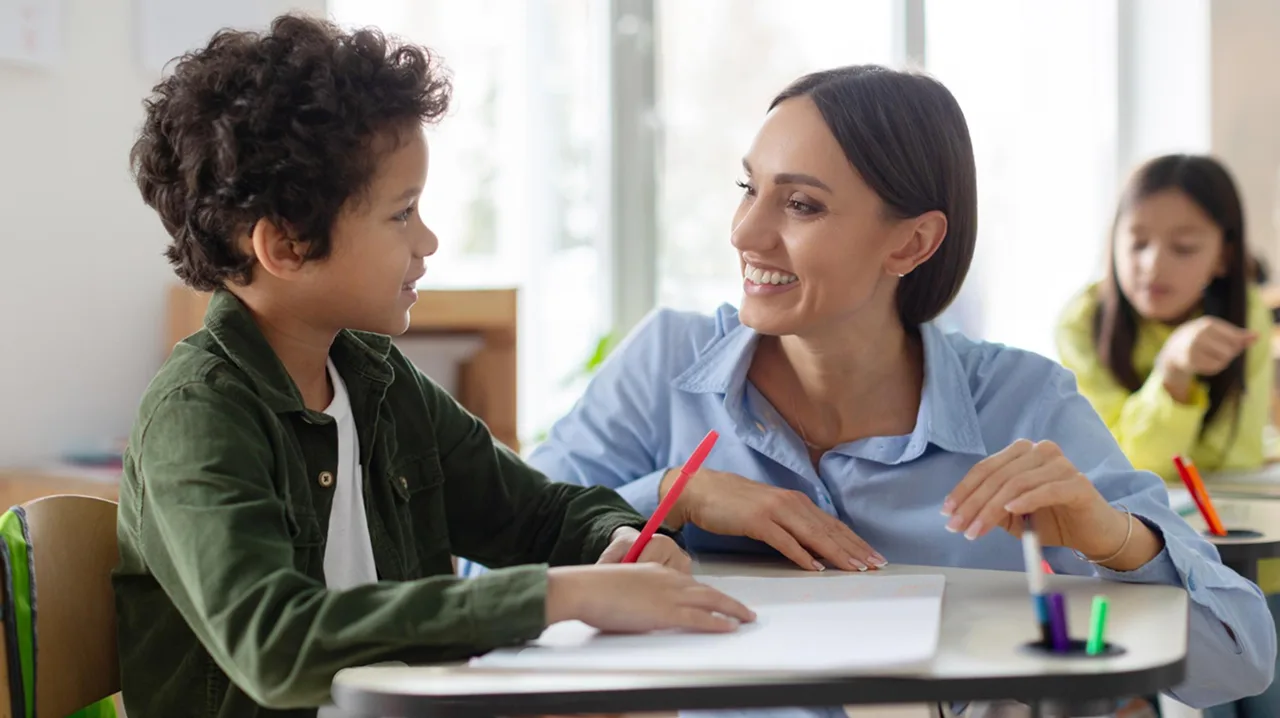
Tiny tots in their preschool-age years convey meaning far beyond language. Their tone, expressions, and body language all convey as much meaning as do words. In order to really connect with them, teachers and parents both need to understand and enjoy the verbal and non-verbal communication in preschool.
The children at this stage learn differently from older children. They majorly base their understanding on observation, repetition, and interaction. Teachers at the best preschool in Pune communication practices emphasise observing how children hear tone, facial expression, and simple words. By learning these nuances, teachers enable early childhood learners to develop early childhood communication skills that become the foundation of literacy and assertive self-expression.
Experiential examples play an essential role in learning. Different things, like the use of puppets or gestures, can be used by teachers to impart meaning or demonstrate lesson instructions in a simplified way. Another way children tend to learn is through imitating adults; hence, positive and consistent gestures and body language in teaching greatly improve understanding. Asking children to communicate using gestures, drawings, and plain words helps them learn and communicate better. Such methods not only increase confidence but also enable children to become active learners in their learning process.
Learn more: Importance of Early Childhood Education.
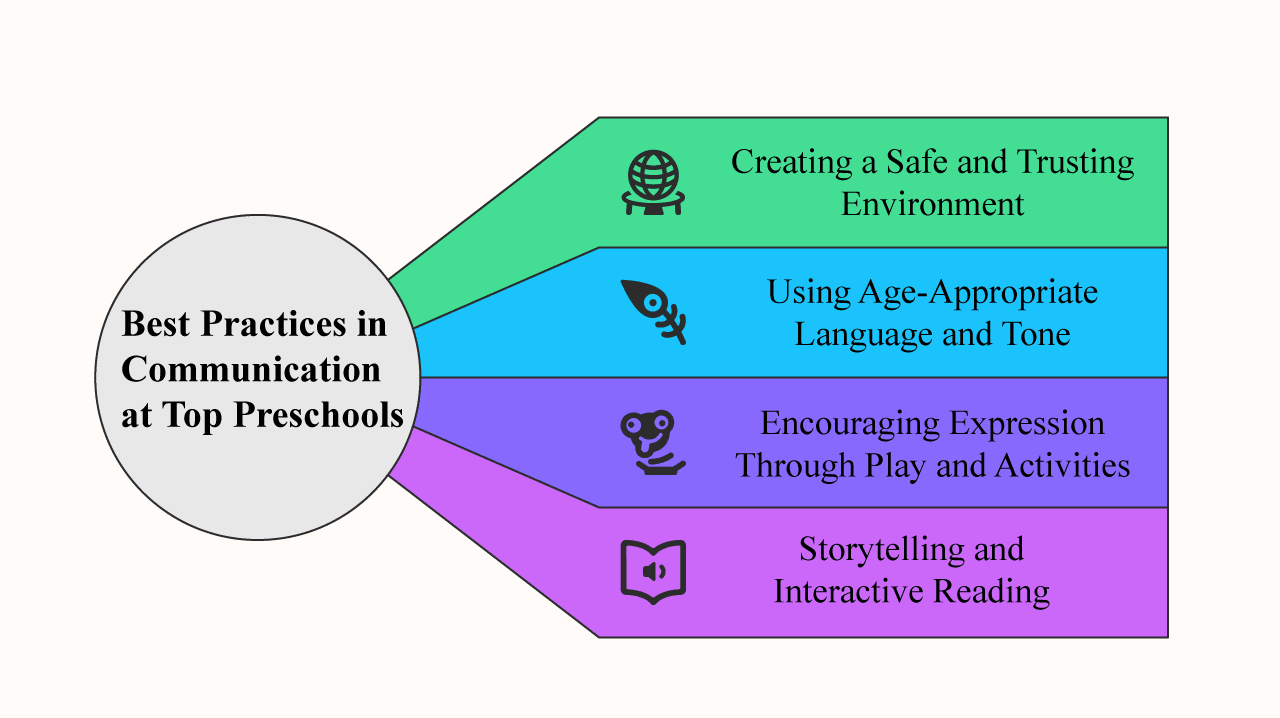
Best Practices in Communication at Top Preschools
-
Creating a Safe and Trusting Environment
-
Using Age-Appropriate Language and Tone
-
Encouraging Expression Through Play and Activities
-
Storytelling and Interactive Reading
Many preschools provide “circle time” in which children are gathered for a teacher-child discussion of thoughts and feelings. This happens every day, and it shows children they are important and that their voice matters. Second, gestures such as greeting each child with warmth and celebrating their efforts contribute to building trust and confidence. When children know they are respected and appreciated, they are more willing to speak openly and engage in group learning.
Teachers at top preschools in Pune understand the importance of using age-appropriate communication. Complex instructions or abstract ideas can overwhelm young learners. Instead, they use simple words, soft voices, and open gestures to communicate tasks. Following appropriate preschool communication strategies, a child can understand concepts straight away and feel involved in the experience of learning. A soothing and warm tone of voice in teaching helps relieve anxiety amongst children, allowing them to respond better and build a stronger bond with their teachers.
While selecting the vocabulary, the language suitable for the age is considered. For example, a teacher may use “circle” instead of “sphere,” connecting the concept to something familiar in a child’s daily life, making communication meaningful and accessible. Being sensitive to a child’s level of development enhances trust and comprehension. Gradually, children feel comfortable enough to test new words, both expanding their vocabularies and their confidence.
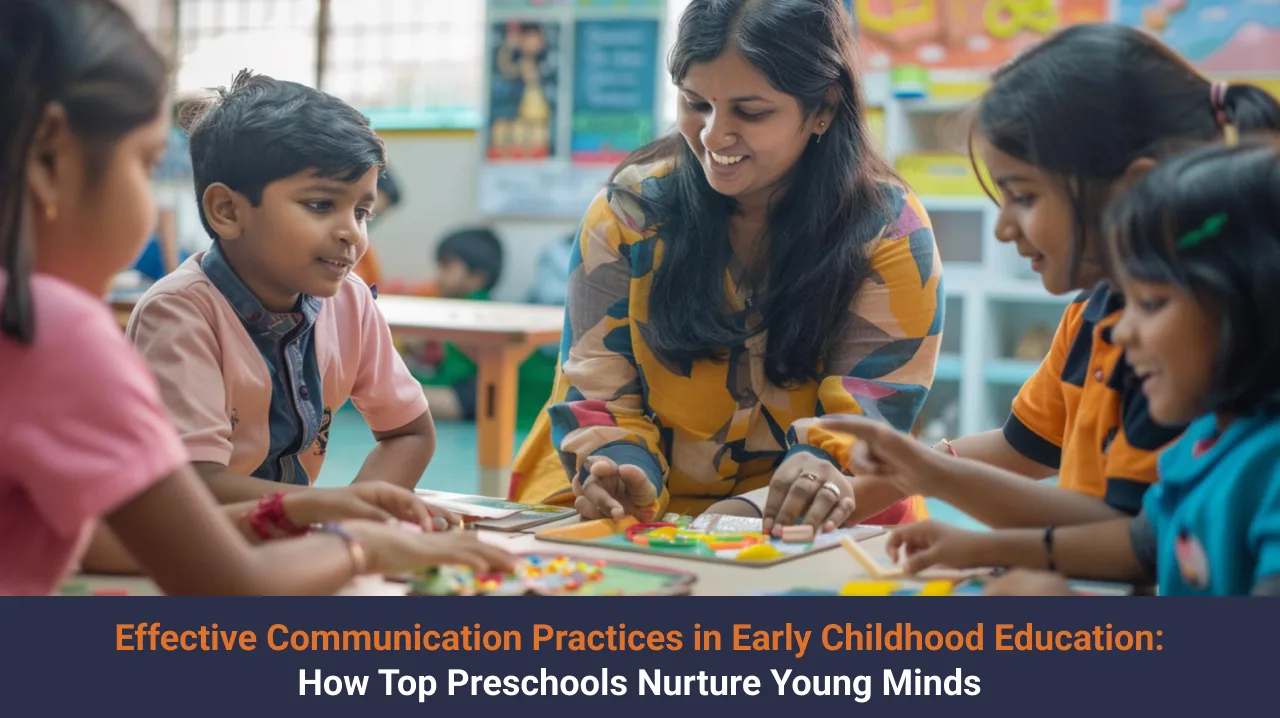
Play is fun and also a good way to communicate. Group activities and structured play encourage them to talk, share, and work together. When children play, they learn, practice their voice, develop language, and create social bonds. Teachers engage students in preschool expression activities such as art, drama, or role-playing so children may express themselves creatively. These activities represent the importance of communication in early childhood development, and in play-based learning, play becomes a bridge for developing both social and language skills.
Take role-playing for example. When a child pretends to be a shopkeeper and another becomes the customer, they are not only laughing and enjoying themselves—they are practicing vocabulary, problem-solving, and social communication without even realising it. In art sessions, when children describe their drawings, they learn how to tell stories and express feelings. Play makes creative communication in early years enjoyable, and thus, it turns the classroom environment into an interactive one where learning occurs naturally and is fun.
Storytelling and reading aloud are age-old techniques that promote vocabulary and understanding. Storytelling in preschool draws children in, making them curious and excited to listen. Similarly, interactive reading for children allows students to ask questions, make predictions, and link the stories to their own lives. This type of technique leads to early literacy development, while also nurturing a deep love for language.
In the same sense, interactive reading for children makes them curious. The teacher could stop to ask the child what they think will happen next. This simple exchange strengthens vocabulary, builds listening skills, and teaches them to make connections. Likewise, Cultural stories and everyday tales add even more value by linking a child’s background with their current world, giving learning both meaning and relevance.
Read more: Importance of Early Childhood Education.
Involving Parents in the Communication Process
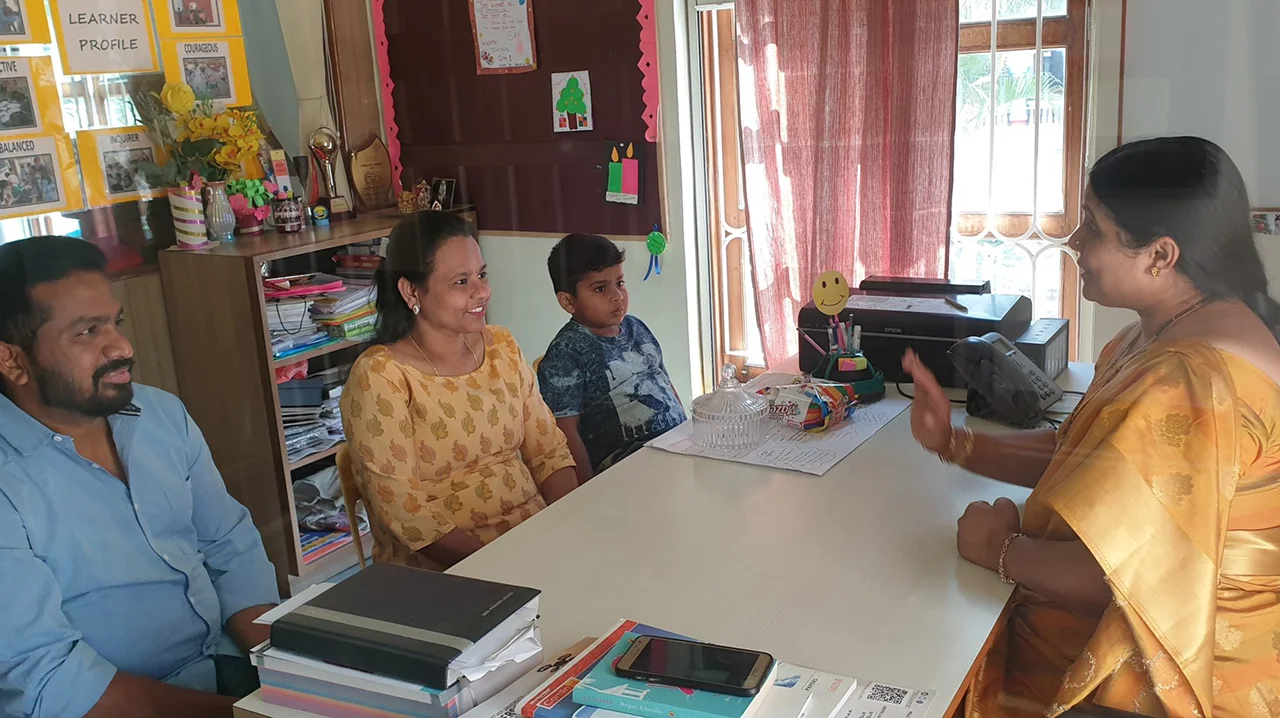
Preschools that promote parent-teacher communication extend learning beyond the immediate walls of the preschool. Feedback, progress sharing, and collaborative feedback keep parents engaged and updated about their child’s current status. Parents can be given tips for improving home communication, e.g., asking children to recount their day or engage in family conversations. This home-school partnership establishes consistency in how children perceive communication.
Some of the other workable approaches include organising parent-teacher meetings where detailed observations can be shared, or newsletters could be sent to parents detailing activities in the classroom. Parents can also be encouraged to carry on with communication practices at home through bedtime stories, open-ended questions, and active listening. By joining hands, the two ensure that children get to experience the best ways in communication development. Perhaps in this way, they pick up stronger and more consistent communication behaviours.
Active parental involvement promotes bonding and facilitates growth in the early childhood days. Sharing student milestones with parents daily not only comes with celebration but also brings attention to where parents can help. This statement sums up that the best preschool in Pune’s communication practices is not limited to the teachers and children but includes parents. In their lifetime, this teamwork develops resilience among children and enables them to express themselves in different environments.
Read more: Can Teachers and Parents Work Together to Facilitate the Best Learning Experience for Kids?
How MIT Gurukul Implements These Practices
At MIT Gurukul, we understand the importance of communication during the early childhood learning days. Here are the ways we use to incorporate better communication-building strategies in all our programs.
- Teacher Training: Teachers are constantly involved in courses around communication. Also, they are regularly trained in different ways to foster children’s engagement in communication through verbal and nonverbal approaches. The workshops have modules that focus on reading emotional cues, changing levels of tone, and working on storytelling skills.
- Activity-Based Language Development in Preschool: Daily classroom routines encompass storytelling, role-playing, and games that stimulate interaction. By facilitating such daily language development activities for preschoolers, students increase their communicative competence, all while remaining engaged and having fun. Teachers facilitate this collaborative communication development by having the students work in pairs or small groups, providing them with an opportunity to refine their collaborative communication skills in as close to a real-life experience.
- Parent Involvement in Early Learning Sessions: Parent participation in the classroom beyond the school hours can be done through interaction sessions, workshops and open conversations. This contributes to the establishment of a strong relationship between home and school that always reinforces learning. For example, family reading days or parent and child art activities also enhance the shared experience and emphasise the shared responsibility of communication.
Read more: Academics at MIT Gurukul – World-Class Education for Your Child’s Future.
Conclusion
Preschool communication strategies shape not just early learning but also future relationships, whether by creating a safe space in the classroom or by involving parents in the process. Effective communication in early childhood education is about so much more than academics; it gives children confidence, helps them find their voice, and nurtures the curiosity that will guide them throughout life. By embracing these practices, the best preschool in Pune communication practices develops a well-rounded setting where each child feels listened to and appreciated.
At MIT Gurukul, this philosophy is lived in every classroom. Teachers listen patiently, encourage interaction, and partner with parents to give each child the strongest possible start. By weaving effective communication practices into daily learning, MIT Gurukul builds not just bright students but confident, empathetic young learners. Learn about MIT Gurukul’s Early Years Programme today and see how communication is used to foster confident learners.