


Advantages of Reading Newspaper for Students & Tips to Cultivate the Habit

Reading is a pertinent and advantageous habit for students. It helps them gain knowledge in a self-paced manner and adds to their intellectual development. Reading books is the most common activity among students, but reading newspapers must be encouraged too. It has its distinct advantages since newspapers provide information on varied topics, as well as general knowledge. Newspapers include details about economic conditions, trade and commerce, healthcare, sports, entertainment, world news, fashion, environment etc. Reading newspapers thus helps widen the students’ outlook and enriches their knowledge base. Some of the benefits of reading newspapers for students can be outlined as below: * Improved knowledge and vocabulary With a wide variety of topics covered in the newspapers daily, every student will find news articles that interest them. From discoveries and innovations to climate change and environment to art and culture to sports, politics and finance, there is a plethora of information to soak in. This helps enhance the general knowledge as well as the vocabulary of the students. New words, writing styles and thoughts expressed better the students’ writing prowess too. * Enhanced critical thinking skills and exposure to different perspectives As students read news, views and critiques by subject experts in newspapers, their ability to analyse and reflect upon what they read also improves. They may agree or disagree with opinions and perspectives expressed in the news articles. This raises their quotient for creative and critical thinking, logical deduction and making connections between seemingly diverse aspects. This also helps the students to develop the skill to respect divergent views, and understand the context within which such views are formulated. * Awareness of current affairs In today’s competitive parlance, it is necessary that students have knowledge of the dynamically changing world scenario. An ideal way to enable this is through regular newspaper reading. The importance of newspaper reading is evidenced from the fact that no other publication includes as many varieties of news and other information that newspapers do. They also have information on current affairs, which are written in very simple to increasingly complex formats so that students of all age groups can find age-appropriate reading materials. The best schools in Pune, including MIT Gurukul, thus subscribe to newspapers and have dedicated libraries and reading times for their students. * Development of reading and literary acumen If students read newspapers in different languages, it has its added advantages. They are exposed to different literary and linguistic traditions, grasp the nuanced variations in language expressions and get exposed to creative writing styles in various languages. It provides them a vast canvas of thoughts and the ability to engage in fruitful discussions with their peers, teachers and family. Over time this becomes a healthy extracurricular immersion that also prevents students from excessive social media indulgence. This becomes a lifelong habit and a beneficial outcome of reading newspaper. Considering that newspaper reading has immense benefits, a few tips can help students develop consistent reading habits. Teachers at school and parents at home can support the students in developing these reading disciplines. [INSERT_ELEMENTOR id=”5216″] Tips to Cultivate the Habit of Reading Newspaper: * Set aside dedicated time for reading The advantages of reading newspapers can be best reaped when the student is attentive and focused; hence the choice of reading time should be made by the student. Every student has their preference for the time of the day when they like to read. Newspaper reading can be incorporated within such preferred time so that a dedicated time each day can be set aside for this activity. * Choose a newspaper that suits your interests and level of comprehension Reading information or news that the student can easily understand helps keep the motivation for reading intact. Different newspapers contain sections for quizzes, Sudoku, joining the dots activities, news about schools and children appropriate events etc. The newspapers also have different sections for news about finance, politics, international affairs and the like. Newspapers such as Economic Times focus more on trade, and the education section of newspapers offers information on national and international universities and courses. Students can choose the newspaper that best suits their interests and the level at which they can comprehend the information. * Make notes and summaries to retain information When a student finds a news article that syncs with their academic subjects, a good practice to retain information would be to take notes. Summarising such news articles in one’s own words can also help tackle specific aspects of International baccalaureate subjects. Some examples include extended essays and the theory of knowledge assignments, for which such summarised notes can prove very useful. Further, notes become a ready reference and build upon the formal classroom learning of the student. * Discuss news articles with others Discussing what one has read in the newspaper with classmates, teachers, friends and family can also boost the reading habit. Sharing information, ideas and one’s views on the read news or articles also provides the student with the aptitude for gathering a variety of perspectives about the same set of information. It also helps them generate ideas for work and school assignments and produce high-quality academic output. * Use technology to access newspapers If newspapers are easily accessible, the chances that students will read them regularly will be more. Reading online versions of newspapers makes them available at the click of a button and keeps the students on track with their reading time each day. Students can also send their classmates electronic copies of interesting articles and initiate a knowledge-sharing practice. Thus leveraging technology to develop this fruitful habit is a positive way to hone reading among students. Within international baccalaureate diploma programme curriculums, emphasis is laid upon reading, which includes various newspapers being made available to students at all times. In developing the newspaper reading habit, initially, students may face challenges. Over time, with consistent effort and encouragement from teachers and parents, this becomes a regular part of the routine. Potential Challenges and How to
Fostering a Love of Learning: How the IB EYP Encourages Curiosity and Creativity

Table of Contents Nurturing curiosity, creativity, and critical thinking skills is the ultimate aim of any education. A good education fosters out-of-the-box thought process, the ability to look at varied perspectives for a given problem, and finding optimum solutions for it. The earlier these qualities are espoused in life, the stronger and better they become over time. Addressing these requirements is the globally known and recognized International Baccalaureate Early Years Program (EYP) for very young students in school. The EYP was instituted to focus on the children’s total growth and touch their minds and hearts for holistic development. In addition to academic development, the EYP curriculum encompasses the social, physical, emotional and cultural inputs into children. It creates an engaging, challenging and significant education through a multitude of teaching methodologies that include classroom instruction, play-way methods, experiential exposures and field visits. Learning the IB EYP curriculum has many advantages to lay a strong academic foundation. These include: It encourages curiosity The EYP program encompasses five elements that help young students develop the curiosity to learn and grow. These include diverse feedback pathways, encouraging self-regulated learning, nurturing an inquisitive mind, facilitating creative collaboration, and exercising choice over self-expression. By letting children learn at their own comfortable pace and giving feedback on their progress, teachers create an atmosphere of positive reinforcement that motivates the students to learn better. Group activities and play time fosters teamwork and cooperation abilities in students, and each child is allowed to express their creativity in a way that brings out their best abilities. Children are lauded for academic excellence and their skills in art, craft, sports, etc. It fosters creativity By giving the young students open tasks and letting them work in groups and teams, their teamwork and time management gets better. By providing clear and concise guidelines for their work, and by providing a gentle and caring support for them to overcome learning challenges, the creativity in them is fostered. Children indulge in activities such as solving simple puzzles, finding ways to combine related articles or ideas, and making connections between things. It could be an activity such as sowing seeds and watching the saplings grow over a period of time or mixing two colours and finding a new colour emerge from it. These help the students get comfortable with experimenting and self-learning, which also helps them in their later years. Most IB board schools in India follow this teaching and learning methodology for their EYP year students. It integrates technology to facilitate learning Technology is a great enabler of learning. Through multimedia, young students can learn by watching short movies, fun-filled cartoons, looking at how a craft is done, the stages of how seeds germinate and grow into small saplings, or how the birds fly. These seemingly simple things go a long way in helping children visualise how things happen in the real world and grow their facility and comfort with the use of technology as they grow and go through the PYP and the DP curriculums in later years. In the present world, the ability to utilise technology for learning, undertaking research, projects and other activities is an essential skill, and the EYP program sets the tone for positively honing this skill. It employs novel assessment and evaluation methods Rather than just focusing on the academic achievements, the EYP program encourages the overall development of children. Thus it uses continuous comprehensive evaluation methods for the students’ assessment. Through this practice, every aspect of a child’s personality is allowed to bloom. Children get evaluated on their studies, sports, artistic abilities, simple activities that they do throughout the year, and even for things like cooperation with classmates, truthfulness, keeping things in place after use, helping others, etc. This ensures that they are not only gaining a love for education and growing their intellect but they are also imbibing leadership and communication qualities. Most IB schools and some of the best CBSE schools in India have incorporated this kind of evaluation system. Thus we can conclude that the EYP program is best suited for giving children the vast canvas of opportunities that help them bring out their latent talents and develop an overall amicable, curious and confident personality. With the growing number of IB schools across the globe, including in India, and a large number of parents choosing this curriculum for their children, the future of the EYP program is set to grow in volume and quality. Its merits have been tested by those already enrolled in the program, and as the word is spreading among other prospective parents and students, there is an increasing leaning towards the IB EYP education. At MIT we have developed a holistic EYP program where our aim is to develop the finest global citizens of the world. We encourage parents to understand this curriculum and help their wards at home so that a reinforcement of their learning is done. To discuss the ways parents can help their child better we also have open houses for meetings between teachers and parents. To view a schedule of such open houses please look at our website https://www.mitgurukul.com/
Positive Mental Health for Educational Success: Simple Daily Habits to Reduce Stress & Improve Focus
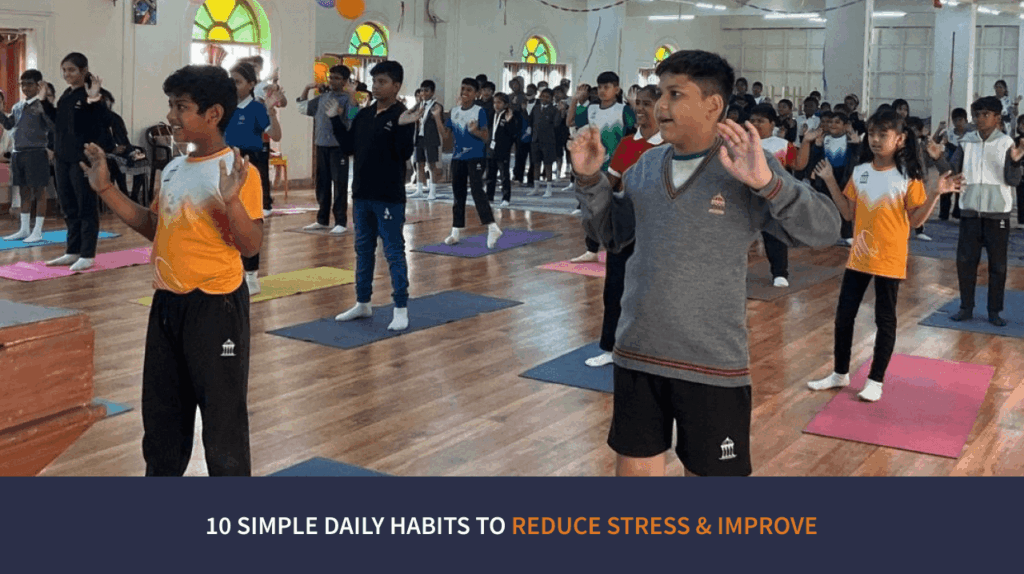
Academic pursuit requires focus, alertness and sharpness of mind. Students must be physically fit and mentally adept to ingrain increasingly complex concepts. Often the idea of mental fitness or positive mental health takes a backseat compared to physical health. However, for comprehensive growth as a scholar, it is very important for students to also hone in habits and routines that aid them in developing and maintaining a good mental health quotient. Mental health should be prioritized within the daily routines of students. Some of the time-tested methods known to bring positive mental health outcomes for all age groups can be applied as easily to young adults and teenage students and even to very young student groups. Some of these healthy daily routines for students involve the following: Morning Schedule Mornings set the tone for the rest of the day. A positive affirmation upon waking up goes a long way in initiating the day in the right direction. Other things like drinking water, stretching, going out into the sunlight, walking or meditating are immensely helpful too. Avoiding screen time in the morning saves precious time for activities like reading, getting ready in time for school and being punctual. The international baccalaureate PYP programs include morning prayers and meditation schedules so students start school on a good note. Exercise Exercise is one of nature’s ways to release happy hormones. They are better than tea and coffee and the best stress busters and health promoters known to humankind. Regular exercise can reduce stress, improve focus, build muscle and keep at bay chronic illnesses later in life. The best daily routine for students can have an ideal mix of yoga, jogging, running, or walking in a park. These do not require expensive equipment and can be done at home or outside. The best ICSE schools in Pune, as also other schools in India, lay emphasis on exercise in the form of yoga and sports within their co-curricular activities. Mindfulness Being present in the moment helps a person reap the best benefits of creative ideas, doing tasks on time, being organized and keeping stress free. Some practical ways to achieve mindfulness are preparing a to-do list for the day the night before, doing meditation or deep breathing exercises, indulging in an activity such as Sudoku or reading books, connecting with nature and doing small chores such as watering the plants etc. Playing with pets is also a good way to be mindful, as is spending time with the family in activities of mutual interest. The best IB schools in Pune, such as MIT Gurukul, have mandatory meditation, book reading etc, in their daily and weekly schedules as the first set of activities in the school timetable. Healthy Eating Food affects not only our bodies but our mind as well. Healthy food leads to healthy neural connections and keeps the mind sharp and ready to acquire knowledge. Starting the day with a nutritious breakfast, having plentiful fruits and vegetables and adequate amounts of water throughout the day helps build a fit body and mental faculties. Within the busy schedule of students, some easy snack ideas can be dry fruits or fresh fruits, multigrain flour bread with protein-rich filings and salads. Traditional home-cooked food is the best option as against eating food from outside or buying junk food. MIT Gurukul, like the other IB boarding schools in India, ensures that its hostel students are given well-balanced and nutritionally rich food to concentrate on their studies. Sleep A good night’s sleep is the best way to wake up fresh, be happy and efficient throughout the day, and maintain optimum mental health levels. Sleep helps dispel both physical and mental fatigue, repairs body cells and maintains the body’s rhythm. The sleep needs to be good quality as well as of optimum length. About seven to eight hours of undisturbed sleep daily is a must for students. A fresh mind can imbibe classroom learning easily. Eating two hours before sleep, avoiding screen time an hour before bedtime, and scheduling bedtime routines are good ideas for sound sleep. Breaks Taking breaks throughout the day between study times gives the students time to relax and return to their studies with renewed vigour. These breaks, which should ideally be technology-free, also help reduce strain on eyes and stress; and improve focus. Spending time with family or friends, playing games, helping the mother in the kitchen, talking to one’s grandparents or taking them for a walk are simple yet powerful ways to utilize study breaks. Top international schools in Pune, such as MIT Gurukul, also have games and sports periods, art classes, music and dance training etc., in between the subject classes to give students artistic and sporty ways of distressing and building mental focus. Conclusively we can say that maintaining mental health for better focus and educational success results from consistent routines and good habits. The school and parents can both play an important role in encouraging and supporting students to develop such habits. We welcome parents to meet our psychology and academic counsellors to understand ways to help their child in such habit formation. To set up a meeting, parents can write to us at counsellor@www.www.mitgurukul.com