


Will Reading Skills Enhance My Child’s Communication Skills?

Human beings connect with each other through communication. It is one of the most effective ways of expressing our thoughts, opinions, ideas and skills. Thus it is important that our communication is precise, clear and understandable. To achieve this, there are many things that one can do, and one of the most effective mechanisms to perfect communication is by forming the habit of reading. Reading is an activity that helps us discover and explore different topics, improves our vocabulary, and refines our grammar and sentence formation. Thus it contributes fruitfully to communication skills in people and makes them effective orators. It is, therefore, important that children form good and diverse reading habits from an early age. In this article, we enumerate how reading helps in the enhancement of one’s communication abilities. Also Read – Benefits of Extracurricular Activities in Child Development How do children learn in IB PYP? Reading exercises the mind – Through reading a variety of texts and books people learn new words, languages, and their culturally unique meanings. Reading also expands one’s imagination; creativity and analytical prowess, as one processes the texts and finds meaningful connections in them. Most IB board schools in India have dedicated time for oral reading in their schedules. Reading helps develop concentration – Indulging in reading activity where one immerses in something that appeals to one’s literary and aesthetic taste makes a person get involved in the reading process and improves focus. This does away with distractions that waste time and energy. With focus, a person becomes more productive, interacts with others better, and expresses their thoughts well. Students from the best schools in India do well as they have been exposed to lots of reading time. Reading facilitates expanding one’s network – Reading enables one to learn about different countries, cultures, languages and customs. This helps the person interact confidently with people from different backgrounds and binds strongly with them. Reading also advises about the dos and don’ts of communication within different settings thus making the person able to communicate culturally appropriately. Also Read – The Finest Practices Followed by Best Preschool in Pune to Make Communication Effective With Children. Best Ideas to Keep Your Child Stay Organised. 5 Reasons Why You as a Parent Should Consider IB Education for Your Child Reading helps vocabulary – It is rightly said that reading expands our knowledge of words and their subtle and nuanced meanings. It thus makes us good speakers, better writers, and, consequently, effective communicators. In residential boarding schools in India, among which MIT Gurukul is a leading institution, a lot of emphasis is laid on reading various texts and books. Reading helps reflection – As one reads more and more, the habit helps a person to reflect upon ideas, think about them, and process them for use in different situations and with people. This makes a person wise and careful with communication, leading to positive communication patterns. [INSERT_ELEMENTOR id=”5216″] Thus, reading leads to good and positive communication that is empathetic, culturally appropriate, brief and meaningful and honest. Good communication is all about being confident, speaking with an intent to connect with others and leaving a good feeling amongst all at the end of a communication. This can be helped with good reading habits, including oral reading that improves the content and the tone of communication. MIT Gurukul being mindful of this has well-stocked libraries and dedicated library and reading times for students so they can become tomorrow’s leaders through enhanced communication skills.
Top 10 Impressive & Interesting English Speech Topics for Students
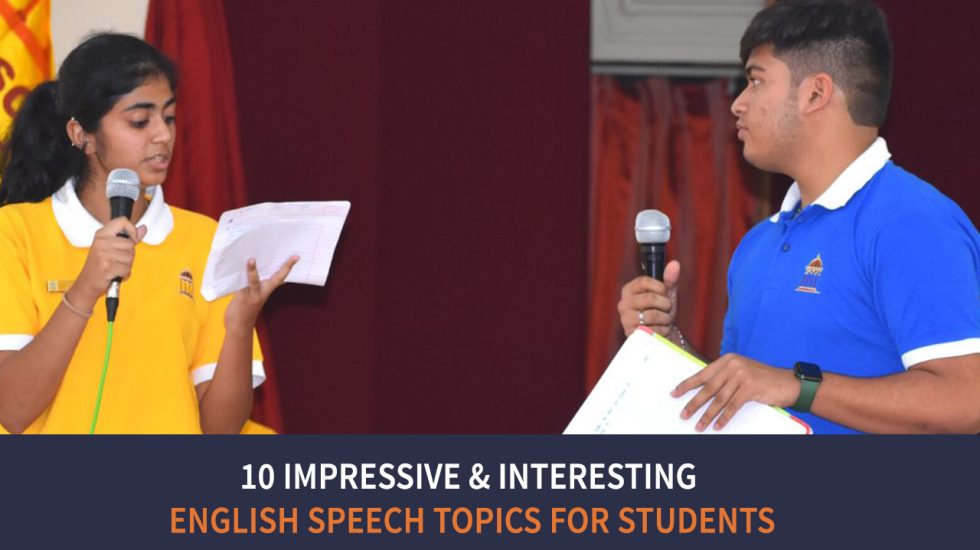
A speech is a formal or informal talk given in front of an audience. Through a speech, a person can express ideas, thoughts and opinions. Speeches are of different types and with varied purposes. They are delivered in different circumstances, to varied sets of audiences and for multiple purposes. Based on these distinctions, the most common types of speeches are as follows: 1. Informative speech – This speech is used to make the listeners aware of a certain topic or concepts, and uses facts, data and statistics to back up the claims made in the speech. A speech given by the school head boy to inform about new rules is an informative speech. 2. Entertaining speech – With its aim to amuse or humour the audience, this type of speech is shorter and more focused on a topic or theme. This is not structured and flows based on audience participation and reactions. An example of this could be a principal’s speech before a humorous poetry competition in the school. 3. Demonstrative speech – With audio-visual aids, the purpose of this speech is to make the audience aware of an idea or concept they do not know about. It is also used to demonstrate the use of certain things. For example, a tech company demonstrating new lab equipment in the school uses demonstrative speech for the students. 4. Persuasive speech – When students participate in the Model United Nations and talk about a topic, they are utilizing persuasive speech. They try to convince the audience that they have the correct perspective on any global issue. This speech is generally on more serious societal issues like politics or human rights. 5. Debate speech – As the name suggests, this speech is used while debating on topics, with each speaker taking the opposite views to the debate topic. The purpose of the debate speech is to bring out different aspects of the same idea. This speech follows a set of rules and is time-bound. 6. Motivational speech – When someone is trying to encourage others to undertake tasks, participate in competitions or challenge one’s capabilities to excel in their studies or other aspects of their life, it is called a motivational speech. A speech on Independence Day asking students to become model citizens is an example of a motivational speech. The above broad categories of speeches can be differentiated into various categories or niches. Making speeches for social causes and promoting and working towards equitable education opportunities are popular and socially relevant themes. Science-related research or innovation, environmental sustainability and talking about renowned personalities for setting a good example to students and youngsters, are also popular speech niches. These make some of the best speech topics for students and are used by the top international schools in Pune and other cities as part of their yearly calendar of events. [INSERT_ELEMENTOR id=”5216″] Once we have understood the types of speech, the next point to consider is which speech topic to choose. While there are no best topics for speech, yet few topics are more suitable for school students, and these are: 1. Social media boon or bane – With increasing technological use starting with the school years and even before, this makes an engaging and a unique topic for a speech. The speech giver can list the benefits and dangers of social media and encourage responsible use of the internet among students. IGCSE boarding schools in India generally include this topic in their morning assembly speeches. 2. Why should every citizen vote – This speech topic rates among the best speech ideas for students since the need to grow as a positively contributing voter and knowing about one’s right to vote should be inculcated in students early in life. 3. Importance of books and reading – Reading stimulates the brain, grows imagination and critical thinking and helps increase one’s knowledge and vocabulary. Thus this is a good English speech topic. Most residential schools in Pune stock their libraries well to help the students read. 4. Importance of extracurricular activities – To develop a holistic profile, students must have good extracurricular interests and academic pursuits. Most schools in Pune have extracurricular offerings for students. Hence this is the best topic for speech for informative purposes. 5. Education for girl child – With the percentage of girls in higher education much less than that of boys even in the present, a speech on this topic that outlines The importance of girls’ education will make a motivating speech Impact people’s thoughts in a positive manner. 6. Plastic waste and how to tackle it – This is a great speech idea for students as it will help make them responsible for preserving the earth and reducing pollution that is killing many animals, birds, and fish species. 7. How to overcome exam fear – With many students feeling anxious and fearful before exams, this speech topic is a wonderful way to help alleviate their fears and instil in them the confidence that they can do well in their exams. 8. Smart studying tips – Making a speech about study strategies can help students decipher good ways to learn Retain their texts Consequently do well in their exams. 9. Health is Wealth – This is a pertinent topic for speech for students since good habits that promote positive health and well-being are to be ingrained in children from a young age. With this topic, the speaker can enumerate the importance of regular exercise, good nutrition and meditation. Most IB schools in Pune and other Indian cities introduce holistic health practices for students. 10. Respect and care – A very important speech topic that must be a part of every school curriculum and calendar of events. This helps students grasp that respect and care are two pillars of human behaviour that strengthen human societies. Whatever the topic may be, it is crucial that the person making the speech should prepare it in detail and practise it so that the presentation, language flow, and confidence with which the speech is delivered are of high quality.